Amazon seller step by step guide for success in 2026
Author: Adi Malai | Category: Blog | Reading time: 15 min

Setting up an Amazon Seller Central account might seem overwhelming with the platform’s extensive features, documentation requirements, and optimization strategies. Yet every successful seller started exactly where you are now. This guide breaks down the entire process into clear, actionable steps that simplify account creation, product listings, see our account management services, advertising, and growth strategies to help you build a thriving Amazon business in 2026.
Table of Contents
- Amazon’s Market Opportunity In 2026
- What You Need Before Creating Your Amazon Seller Central Account
- Step 1: Create Your Amazon Seller Central Account
- Step 2: Use Amazon’s Seller Resources For A Strong Start
- Step 3: Conduct Data-Driven Product Research
- Step 4: Optimize Your Product Listings For Visibility And Conversions
- Step 5: Fulfillment Options FBA Vs. FBM
- Advanced Step: Advertising And PPC Optimization On Amazon
- Building And Promoting Your Amazon Brand
- Common Mistakes To Avoid As An Amazon Seller
- Expected Sales Growth And Timeline For Amazon Sellers
- Enhance Your Amazon Selling Journey With Expert Support
Key takeaways
| Point | Details |
|---|---|
| Amazon dominates U.S. ecommerce with 38% market share, offering sellers immediate access to millions of active buyers ready to purchase. | |
| Account setup requires specific documents including government ID, bank account info, credit card, and tax identification for verification. | |
| Product research using data-driven tools and listing optimization with strategic keywords directly impact search ranking and conversion rates. | |
| Sellers using Amazon’s New Seller Guide achieve six times more first-year sales compared to those who skip these foundational resources. | |
| Realistic growth timeline spans 3 to 6 months with consistent execution of PPC optimization, brand building, and policy compliance. |
Amazon’s market opportunity in 2026
Amazon continues to dominate the digital retail landscape. Amazon holds 38% of U.S. ecommerce market share, giving sellers immediate access to hundreds of millions of active customers actively searching for products. This massive built-in audience eliminates the need for extensive customer acquisition efforts that plague standalone ecommerce sites.
The platform’s infrastructure supports both new and experienced sellers with tools, logistics, and marketing capabilities that would cost millions to replicate independently. Prime membership alone drives repeat purchases and higher average order values, creating a virtuous cycle for sellers who master the platform.
Key benefits of selling on Amazon in 2026 include:
- Direct access to over 300 million active customer accounts worldwide
- Built-in trust and credibility from the Amazon brand reducing buyer hesitation
- Fulfillment and logistics infrastructure through FBA that scales with your business
- Advertising tools that target high-intent shoppers already browsing similar products
- Mobile-optimized shopping experience capturing the growing mobile commerce trend
Integrating Amazon into an omnichannel retail strategy amplifies brand visibility across multiple touchpoints. Customers who discover your products on Amazon often seek out your brand on other platforms, creating a multiplier effect that extends beyond a single marketplace.
What you need before creating your Amazon Seller Central account
Proper preparation prevents delays and frustration during account setup. Amazon requires specific documentation to verify your identity and business legitimacy before granting selling privileges.
Essential documents and information include:
- Valid government-issued photo ID such as passport or driver’s license
- Business or personal bank account with routing and account numbers
- Internationally chargeable credit card for monthly subscription and selling fees
- Tax identification number like SSN for individuals or EIN for registered businesses
- Phone number for two-factor authentication and account security
Beyond paperwork, successful sellers enter the marketplace with foundational ecommerce knowledge. Understanding profit margins, shipping logistics, and customer service expectations helps you make informed decisions from day one. Researching your product niche before registration allows you to hit the ground running once your account activates.
Product research tools significantly increase your odds of selecting profitable items. Platforms like Jungle Scout, Helium 10, and AMZScout provide data on search volume, competition levels, and estimated sales that remove guesswork from product selection. While these tools require subscription fees, the investment pays dividends by steering you away from oversaturated markets and toward genuine opportunities.
Pro Tip: Gather all required documents and have them scanned or photographed before starting registration. Amazon’s verification system may request additional documentation, and having everything ready speeds up approval from days to hours.
Step 1: Create your Amazon Seller Central account
Registration follows a structured process that verifies your identity and establishes your seller profile. Navigate to sellercentral.amazon.com and click the registration button to begin. Amazon offers two account types: Individual for sellers moving fewer than 40 units monthly, and Professional for higher-volume sellers who want access to advanced tools and advertising.
Understanding the types of Amazon seller accounts helps you choose the right starting point. Professional accounts cost $39.99 monthly but waive per-item selling fees and unlock bulk listing tools, making them cost-effective once you exceed 40 monthly sales.
Follow these registration steps:
- Enter your email address and create a secure password with uppercase, lowercase, numbers, and special characters
- Provide your legal business name or personal name if selling as an individual
- Upload your government ID and wait for automated verification, which typically completes within minutes
- Enter bank account details for payment deposits, ensuring all information matches your bank records exactly
- Add credit card information for monthly fees and any applicable selling charges
- Complete tax interview questions to establish proper tax withholding and reporting
- Verify your phone number through a text message or automated call with a verification code
- Wait for final account approval, which ranges from 24 hours to several days depending on verification complexity
Common delays occur when document images are blurry, names don’t match exactly across documents, or bank information contains typos. Double-check every entry before submitting to avoid back-and-forth with Amazon’s verification team.
Pro Tip: Use a business bank account even if you’re starting as an individual seller. This separation simplifies accounting and tax preparation while making it easier to scale into a formal business structure later.
Step 2: Use Amazon’s seller resources for a strong start
Amazon provides extensive educational resources specifically designed to accelerate new seller success. The New Seller Guide offers step-by-step walkthroughs covering everything from product research to your first sale. Data shows that New Seller Guide users achieve six times more first-year sales compared to sellers who skip these materials.
Seller University houses hundreds of video tutorials organized by topic and skill level. These free courses cover inventory management, advertising strategies, policy compliance, and advanced optimization techniques. The bite-sized format lets you learn specific skills exactly when you need them rather than forcing you through lengthy courses.
Key resources to prioritize include:
- Product listing optimization tutorials that demonstrate keyword placement and image requirements
- Fulfillment by Amazon walkthroughs explaining inventory prep and shipment creation
- Advertising fundamentals covering campaign structure and budget management
- Policy compliance guides preventing common violations that trigger account suspensions
- Seller forums where experienced sellers share real-world solutions to common problems
The seller community forums connect you with thousands of active sellers facing similar challenges. Search existing threads before posting questions, as most common issues already have detailed solutions. Engaging with the community builds relationships that often lead to partnerships, sourcing tips, and insider knowledge that courses can’t provide.
Allocate your first week to exploring these resources before listing products. This upfront investment prevents costly mistakes and positions you to implement best practices from your very first listing.
Step 3: Conduct data-driven product research
Product selection makes or breaks your Amazon business. Emotional attachments to product ideas often lead to inventory that won’t sell, while systematic research identifies genuine market opportunities with proven demand.
Profitable products share six critical characteristics:
- Retail price between $15 and $50 balancing profit margins with impulse purchase psychology
- Lightweight and compact dimensions reducing storage and shipping costs
- Low seasonality maintaining consistent sales throughout the year
- High search volume indicating strong customer demand
- Moderate competition with opportunities to differentiate through quality or features
- Profit margin of 30% or higher after all Amazon fees and product costs
Product research tools eliminate guesswork by providing concrete data. Jungle Scout’s database shows historical sales estimates, current seller counts, and review patterns for any product category. Filter results by these six characteristics to identify opportunities that align with your budget and experience level.
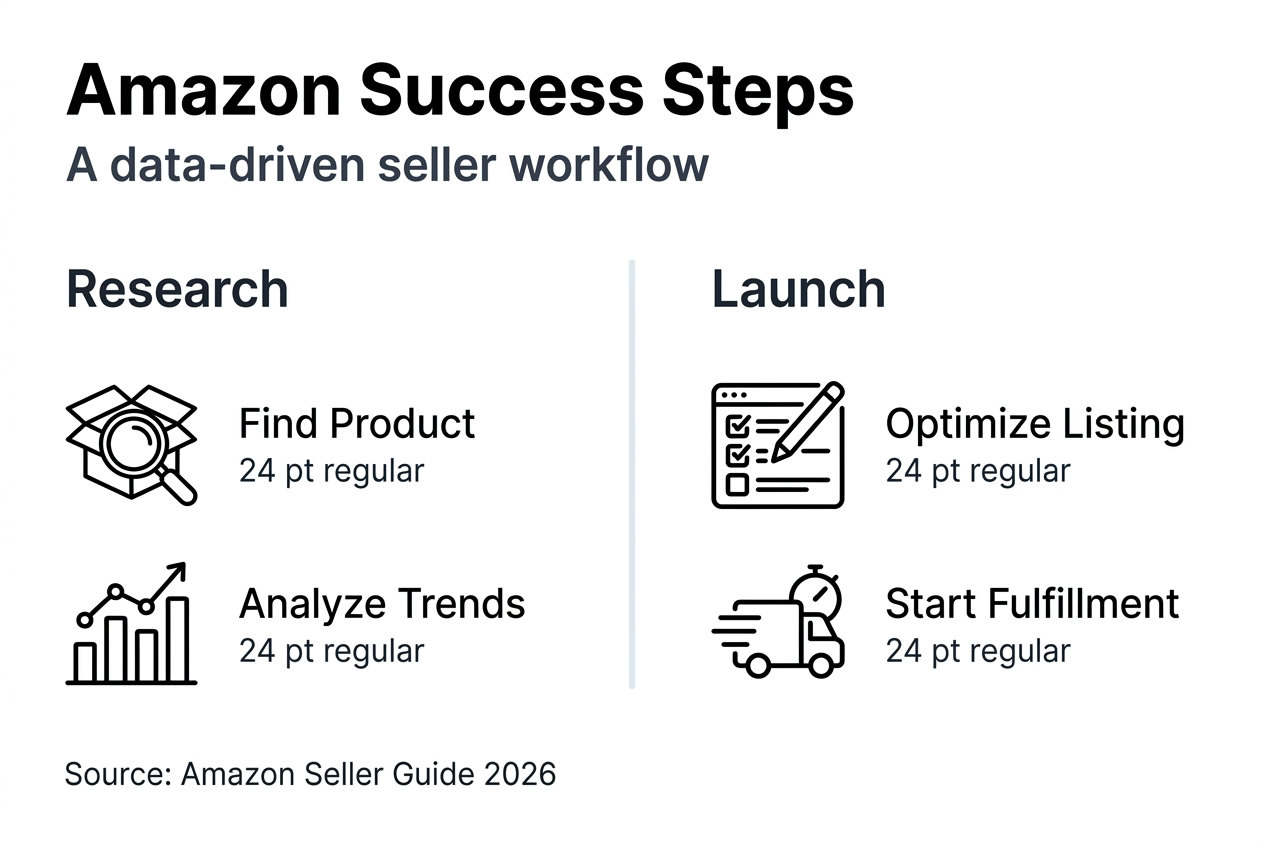
Validating demand requires analyzing multiple data points:
| Research Factor | What to Evaluate | Impact on Success |
|---|---|---|
| Search Volume | Monthly searches for main keywords | High volume ensures sufficient customer demand |
| Competition Level | Number of sellers and their review counts | Moderate competition allows new sellers to gain traction |
| Price Points | Average selling prices in category | Determines your profit potential and positioning strategy |
| Review Quality | Star ratings and common complaints | Reveals opportunities to improve on existing products |
| Seasonality | Sales patterns across 12-month period | Stable demand prevents inventory problems |
Amazon’s Best Sellers lists provide another validation layer. Products consistently ranking in top 100 of their categories demonstrate sustained demand. Avoid the number one spot, as dominant sellers often have unbeatable advantages, but positions 10 through 50 frequently offer room for new entrants who execute well.
Understanding the role of SEO on Amazon informs product selection by revealing search behavior patterns. Products with clear, specific search terms perform better than those requiring customer education or complex explanations.
Step 4: Optimize your product listings for visibility and conversions
Your product listing serves as your sales page, search result, and brand ambassador simultaneously. Optimizing product listings with relevant keywords, compelling descriptions, and high-quality images directly improves search ranking and conversion rates.
Keyword research forms the foundation of listing optimization. Tools like Helium 10’s Cerebro reveal the exact search terms customers use to find products in your category. Prioritize keywords with high search volume and moderate competition, then strategically place them throughout your listing.
Title optimization requires balancing keyword placement with readability. Amazon allows 200 characters, and every character counts for both search algorithms and customer appeal. Include your primary keyword, key features, size or quantity, and brand name in a natural-reading format.
Bullet points highlight benefits and features that convert browsers into buyers:
- Lead with the strongest benefit addressing your customer’s primary pain point
- Include secondary keywords naturally within benefit-focused statements
- Use concrete numbers and measurements rather than vague descriptors
- Address common objections or concerns revealed in competitor reviews
- Maintain parallel structure for professional appearance and easy scanning
Product descriptions provide space for storytelling and detailed explanations. While many mobile shoppers skip this section, desktop users and serious buyers read descriptions carefully. Structure this content with short paragraphs, clear subheadings, and specific use cases that help customers visualize ownership.
Image quality directly impacts conversion rates. Amazon requires at least one image but allows up to nine. Professional photos showing multiple angles, scale context, use cases, and key features dramatically outperform single-angle snapshots. The main image must show the product on a pure white background per Amazon’s requirements.
Pro Tip: Create an infographic image highlighting your product’s top three benefits with icons and brief text. This format communicates value instantly and performs exceptionally well on mobile devices where text is harder to read.
Amazon A+ Content and Enhanced Brand Content let brand-registered sellers add rich media to their listings. These modules include comparison charts, lifestyle images, and detailed feature explanations that increase conversion rates by up to 10%. The investment in professional content creation pays for itself through improved sales performance.
Deep knowledge of Amazon SEO and listing optimization separates successful sellers from those who struggle with visibility. Regular optimization based on search term reports and conversion data keeps listings competitive as market dynamics shift.
Step 5: Fulfillment options FBA vs. FBM
Fulfillment strategy affects everything from profit margins to customer satisfaction and search ranking. Amazon offers two primary models with distinct advantages and trade-offs.
Fulfillment by Amazon handles storage, picking, packing, shipping, customer service, and returns. You send inventory to Amazon’s warehouses, and they manage all logistics when orders arrive. FBA products automatically qualify for Prime two-day shipping, dramatically expanding your potential customer base since many shoppers filter exclusively for Prime-eligible items.

Fulfillment by Merchant means you handle all logistics from your own location or third-party warehouse. You maintain complete control over inventory, packaging, and shipping methods but assume all associated responsibilities and costs.
| Factor | FBA | FBM |
|---|---|---|
| Storage | Amazon warehouses with fees based on cubic feet | Your facility with your own costs |
| Shipping Speed | Automatic Prime eligibility with 2-day delivery | Depends on your shipping methods and carriers |
| Customer Service | Amazon handles all inquiries and issues | You manage all customer communications |
| Fees | Per-unit fulfillment fees plus monthly storage | Your shipping costs plus packaging materials |
| Control | Limited control over packaging and timing | Complete control over entire process |
| Scalability | Highly scalable without additional infrastructure | Requires expanding your own capabilities |
FBA advantages include:
- Prime badge dramatically increases conversion rates and buy box eligibility
- Amazon’s logistics expertise ensures fast, reliable delivery building customer trust
- Hands-off operations let you focus on product research and marketing
- Multi-channel fulfillment option ships orders from other platforms using your FBA inventory
FBM advantages include:
- Lower fees for lightweight items or slow-moving inventory
- Direct control over packaging and branded unboxing experiences
- Flexibility to bundle products or include promotional inserts
- No long-term storage fees for seasonal inventory
Many successful sellers use a hybrid approach. Fast-moving products go through FBA to maximize Prime visibility, while slower items or oversize products ship via FBM to avoid high storage fees. This strategy optimizes for both sales velocity and profitability.
Advanced step: Advertising and PPC optimization on Amazon
Organic ranking takes time to build, making pay-per-click advertising essential for new product launches and sustained growth. Amazon’s advertising platform targets shoppers actively searching for products like yours, delivering higher conversion rates than most other advertising channels.
Sponsored Products ads appear in search results and product detail pages, driving traffic directly to your listings. Start with automatic campaigns that let Amazon’s algorithm match your products to relevant searches, then analyze the search term report to identify high-performing keywords for manual campaigns.
Common PPC mistakes that inflate Advertising Cost of Sales include:
- Bidding on overly broad keywords that attract unqualified traffic
- Failing to add negative keywords that block irrelevant searches
- Setting inadequate daily budgets that pause campaigns before gathering meaningful data
- Neglecting to adjust bids based on actual conversion performance
- Running identical campaigns without testing different ad copy or targeting strategies
Data-driven optimization reduces wasted spend while improving sales. Review campaign metrics weekly, focusing on ACoS, click-through rate, and conversion rate. Increase bids on keywords delivering sales below your target ACoS, and reduce or pause keywords with high spend but no conversions.
Structure campaigns by product category or profit margin to allocate budget more effectively. High-margin products can sustain higher ACoS while building visibility, whereas thin-margin items require tight cost control to remain profitable.
Expert Amazon PPC and account management services help sellers avoid expensive learning curves. Professional campaign optimization typically reduces ACoS by 20 to 30% while maintaining or increasing sales velocity. Proven Amazon PPC optimization strategies combine algorithmic bidding with human insight to maximize return on ad spend.
Building and promoting your Amazon brand
Brand building on Amazon transforms one-time buyers into loyal customers who seek out your products specifically. Amazon Brand Registry provides trademark holders with enhanced content options, brand analytics, and proactive protection against counterfeiters and listing hijackers.
Amazon Stores function as free mini-websites within the Amazon ecosystem. These customizable storefronts showcase your full product catalog with lifestyle imagery, brand storytelling, and curated product collections. Stores receive unique URLs you can promote through external marketing channels, creating a branded destination that feels distinct from the general marketplace.
Key brand-building strategies include:
- Creating cohesive packaging and product design that builds visual recognition across your catalog
- Using A+ Content consistently to establish brand voice and quality standards
- Implementing Subscribe & Save for consumable products to encourage repeat purchases
- Launching complementary products that cross-sell to existing customers
- Monitoring brand analytics to understand customer search behavior and purchase patterns
Promoting your Amazon Store requires a multi-channel approach. Share your Store URL on social media, email marketing, and your own website to drive external traffic. Amazon attributes these visits to your marketing efforts and often rewards external traffic with improved organic ranking.
Brand protection prevents unauthorized sellers from hijacking your listings or selling counterfeit versions. Regular monitoring catches violations early before they damage your reputation or steal sales. Comprehensive Amazon brand management includes proactive enforcement of intellectual property rights and rapid response to policy violations.
Common mistakes to avoid as an Amazon seller
Preventing common pitfalls saves time, money, and potential account suspensions. Learning from others’ mistakes costs far less than making them yourself.
Inventory management failures top the list of avoidable problems. Running out of stock kills your search ranking momentum, as Amazon interprets stockouts as unreliability. Conversely, overstocking ties up capital and generates long-term storage fees that erode profits. Implement reorder point systems based on sales velocity and lead times to maintain optimal inventory levels.
Policy violations trigger account suspensions that can take weeks to resolve. Common violations include:
- Inauthentic or prohibited product complaints from customers or rights owners
- Manipulated reviews through incentivized feedback or fake accounts
- Poor order defect rates exceeding Amazon’s thresholds
- Intellectual property infringement claims from trademark or patent holders
Customer service quality directly impacts your account health metrics. Response time targets require replies within 24 hours, and resolution quality affects your rating. Proactive communication prevents negative feedback and helps resolve issues before they escalate to A-to-z Guarantee claims.
Regular account health monitoring prevents small issues from becoming major problems. Check your Account Health dashboard weekly, addressing any warnings immediately before they accumulate into suspensions.
Understanding why managing seller accounts proactively matters helps sellers prioritize compliance and performance metrics that Amazon weighs heavily in buy box allocation and search ranking.
Expected sales growth and timeline for Amazon sellers
Realistic expectations prevent frustration and premature strategy changes. Most successful sellers follow a similar growth curve with identifiable milestones.
Months 1 to 2 focus on learning and optimization. Early sales trickle in as you refine listings, test advertising strategies, and gather initial reviews. This period feels slow but builds the foundation for future growth. Expect minimal profitability as you invest in inventory, advertising, and learning.
Months 3 to 4 show accelerating momentum as your products accumulate reviews and advertising campaigns optimize. You’ll notice improved organic ranking for target keywords and more consistent daily sales. Profitability improves as you eliminate underperforming products and double down on winners.
Months 5 to 6 deliver measurable results for sellers who execute consistently. First-page rankings for secondary keywords drive organic sales that reduce dependence on advertising. Reduced ACoS from optimized campaigns improves profit margins. Brand recognition from repeat customers and positive reviews creates sustainable competitive advantages.
Typical milestones include achieving 15 to 25 reviews on core products, reducing ACoS below 25%, and generating sufficient profit to reinvest in inventory expansion. Sellers who maintain policy compliance and prioritize customer satisfaction position themselves for long-term scaling beyond the first six months.
Enhance your Amazon selling journey with expert support
Navigating Amazon’s complexity while managing daily operations stretches most sellers thin. Professional support accelerates growth while preventing costly mistakes that drain resources and delay success.
Expert Amazon seller services provide specialized knowledge across PPC optimization, account health management, and brand protection. Data-driven advertising strategies reduce wasted spend while increasing sales velocity, typically lowering ACoS by 30% or more. Full account management ensures policy compliance and optimal performance metrics that protect your selling privileges.
Brand protection services monitor your listings continuously, catching hijackers and counterfeiters before they damage your reputation or steal market share. This proactive approach preserves the brand equity you’ve built through quality products and customer service.
Whether you need comprehensive support or targeted assistance with specific challenges, Agile Consultancy offers flexible solutions that scale with your business. Free account audits identify immediate opportunities for improvement, giving you actionable insights regardless of your growth stage.
FAQ
What documents are required to create an Amazon Seller Central account?
You need a valid government-issued photo ID like a passport or driver’s license, bank account information including routing and account numbers, an internationally chargeable credit card, and tax identification such as an SSN or EIN. Amazon verifies all documentation during registration before activating your selling privileges.
How long does it typically take to see sales growth on Amazon?
Most sellers see meaningful sales growth within 3 to 6 months when consistently implementing best practices for listing optimization, advertising, and customer service. The initial period involves learning platform mechanics and gathering reviews. Results accelerate as your products gain ranking momentum and brand recognition builds.
What is the difference between FBA and FBM fulfillment methods?
FBA means Amazon stores your inventory and handles all picking, packing, shipping, and customer service, while FBM requires you to manage these logistics yourself. FBA products automatically qualify for Prime two-day shipping and appear more prominently in search results. FBM gives you complete control over packaging and operations but requires more hands-on management.
How can I optimize my Amazon PPC campaigns to reduce costs?
Regularly analyze search term reports to identify high-performing keywords and add negative keywords that block irrelevant traffic. Adjust bids based on actual conversion data rather than impressions alone, increasing spend on profitable terms while reducing or pausing underperformers. Professional Amazon PPC optimization services typically reduce ACoS by 20 to 30% through systematic testing and data-driven adjustments.
Amazon Growth Agency · Amazon SPN Approved Partner
Agency specialized in growing brands on Amazon through data-driven PPC strategies, conversion-optimized listings, and complete Seller Central account management.
Recommended
- Amazon Seller Success Factors: 30% Lower ACOS & Brand Protection | Agile Consultancy Blog
- Amazon Seller Blog | Strategies & Insights - Agile Consultancy
- 6 Essential Types of Amazon Seller Accounts Explained | Agile Consultancy Blog
- Master the Amazon Brand Management Process for Growth | Blog Agile Consultancy