Master growth strategy workflow on Amazon in 2026
Author: Adi Malai | Category: Blog | Reading time: 10 min

Scaling an Amazon business profitably remains one of the biggest challenges sellers face in 2026. While many brands chase revenue growth aggressively, they often sacrifice margins and operational efficiency in the process. The marketplace has evolved with stricter fulfillment policies, inventory limits, and rising advertising costs that demand a more strategic approach. This guide walks you through a comprehensive growth strategy workflow designed specifically for Amazon sellers who want to increase sales while protecting profitability and brand integrity in today’s competitive environment.
Table of Contents
- Understanding The Growth Vs Profit Challenge On Amazon
- Preparing Your Fulfillment And Inventory Workflow For 2026 Amazon Changes
- Executing The 7-Part Growth Strategy Workflow To Optimize Sales And Protect Brand
- Scaling Your Amazon Brand Sustainably With Portfolio Management And External Traffic
- Enhance Your Amazon Growth With Expert Consultancy Services
Key takeaways
| Point | Details |
|---|---|
| Profit before growth | Track margins and TACoS metrics before scaling to prevent revenue gains from eroding profitability |
| Hybrid fulfillment models | Combine FBA, FBM, and 3PL services to navigate 2026 policy changes and avoid inventory penalties |
| Structured workflow execution | Apply a 7-step optimization process covering profitability tracking, PPC, pricing, and listing conversion |
| Portfolio scaling strategy | Group 3-7 SKUs sharing supply chains and leverage dynamic pricing for sustainable expansion |
Understanding the growth vs profit challenge on Amazon
Every Amazon seller wants to see their revenue numbers climb, but growth without profitability is just expensive vanity. The fundamental tension between scaling sales and maintaining healthy margins has intensified in 2026 as advertising costs rise and competition deepens across categories. Before you invest in aggressive expansion, you need a solid foundation of profit tracking before scaling to ensure each dollar spent on growth actually contributes to your bottom line.
The key metric shift you need to make is moving from ACoS to TACoS (Total Advertising Cost of Sales). While ACoS measures your ad spend against ad-attributed sales, TACoS calculates your total advertising spend against your entire revenue, including organic sales influenced by your paid campaigns. This holistic view reveals whether your advertising efforts are genuinely growing your business or just shifting sales from organic to paid channels. Focusing solely on ACoS can mask serious profitability problems, especially when your organic rankings decline while ad spend increases.
Many sellers fall into the trap of celebrating top-line revenue growth while their actual profit margins steadily erode. This happens when you scale inventory, increase ad budgets, and expand product lines without tracking the profitability of each ASIN individually. The result is a business that looks successful on paper but struggles with cash flow and sustainability. Understanding top Amazon growth strategies 2026 requires acknowledging this fundamental challenge first.
Practical profit tracking starts with these essential steps:
- Generate weekly profitability reports broken down by individual ASIN to identify winners and losers
- Calculate true landed costs including all fees, shipping, prep services, and storage charges
- Monitor TACoS trends monthly to catch deteriorating organic performance early
- Set minimum margin thresholds for each product category and pause or adjust underperformers
- Track inventory turnover rates to identify slow-moving SKUs draining capital
Pro Tip: Set up automated alerts when any ASIN’s TACoS exceeds 15% or profit margin drops below your category threshold. Early detection prevents small problems from becoming major cash drains.
“Sustainable Amazon growth isn’t about maximizing revenue at any cost. It’s about building a business model where each sales increase strengthens rather than weakens your financial position.”
Preparing your fulfillment and inventory workflow for 2026 Amazon changes
Amazon’s fulfillment landscape has shifted dramatically in 2026, and sellers who ignore these changes risk penalties, stockouts, and compliance violations. The most significant change is the discontinuation of FBA prep services, forcing sellers to handle product preparation externally through third-party logistics providers or prep centers before shipping to Amazon warehouses. This policy shift means your fulfillment workflow must now include an additional step and partner relationship to maintain FBA eligibility.
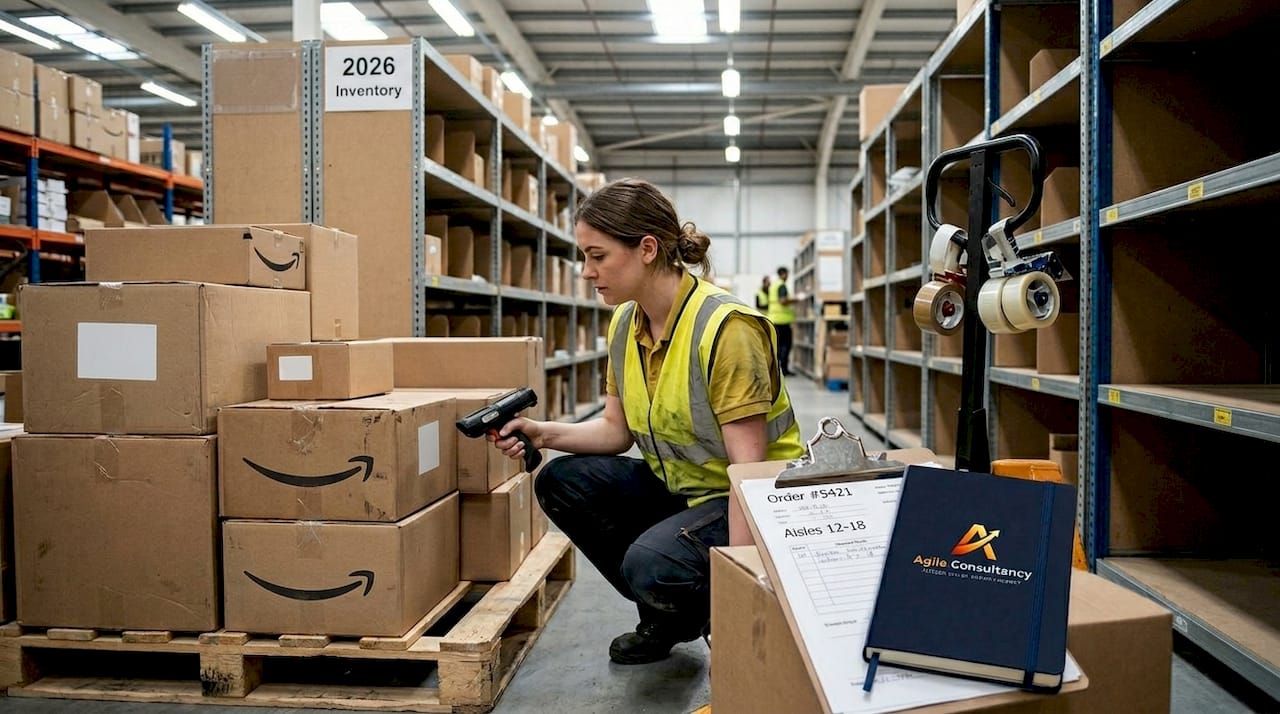
Inventory limits have also become more restrictive and dynamic in 2026, with Amazon adjusting your storage capacity based on your IPI (Inventory Performance Index) score and sales velocity. Sellers can no longer stockpile months of inventory at FBA warehouses without risking overage fees or removal orders. The solution is pre-staging inventory outside Amazon’s network, using 3PL warehouses or your own storage facilities to maintain buffer stock that can be shipped to FBA as space becomes available.
Hybrid fulfillment models now offer the best path forward for most sellers. By strategically combining FBA for fast-moving products, FBM (Fulfilled by Merchant) for slower items or oversized goods, and 3PL partnerships for prep and overflow storage, you gain flexibility while maintaining compliance. This approach also protects you against single-point-of-failure risks if Amazon changes policies or your account faces temporary restrictions. Understanding Amazon inventory management solutions becomes critical for implementing this strategy effectively.
| Fulfillment Method | Best Use Cases | Key Advantages | Main Drawbacks |
|---|---|---|---|
| FBA | High-velocity products, Prime eligibility critical | Fast shipping, Prime badge, Amazon handles returns | Higher fees, strict compliance, limited control |
| FBM | Oversized items, custom products, low-volume SKUs | Complete control, lower per-unit costs, flexible packaging | No Prime badge, you handle all logistics and customer service |
| 3PL | Prep services, overflow storage, multi-channel fulfillment | Scalable capacity, professional prep, backup inventory | Additional partner relationship, coordination complexity |
Your 2026 inventory workflow should follow this structure:
- Source products with lead times factored for both 3PL prep and FBA receiving delays
- Ship to prep center or 3PL for inspection, labeling, and packaging per Amazon requirements
- Monitor FBA inventory limits weekly and schedule shipments to maintain optimal stock levels
- Keep 30-45 days of safety stock at 3PL warehouse ready for rapid FBA replenishment
- Use FBM for products with unpredictable demand or those testing new market fit
Pro Tip: Negotiate volume-based pricing with your 3PL partner and establish clear SLAs for prep turnaround times. A reliable prep partner becomes as critical as your manufacturer in maintaining consistent Amazon availability.
Executing the 7-part growth strategy workflow to optimize sales and protect brand
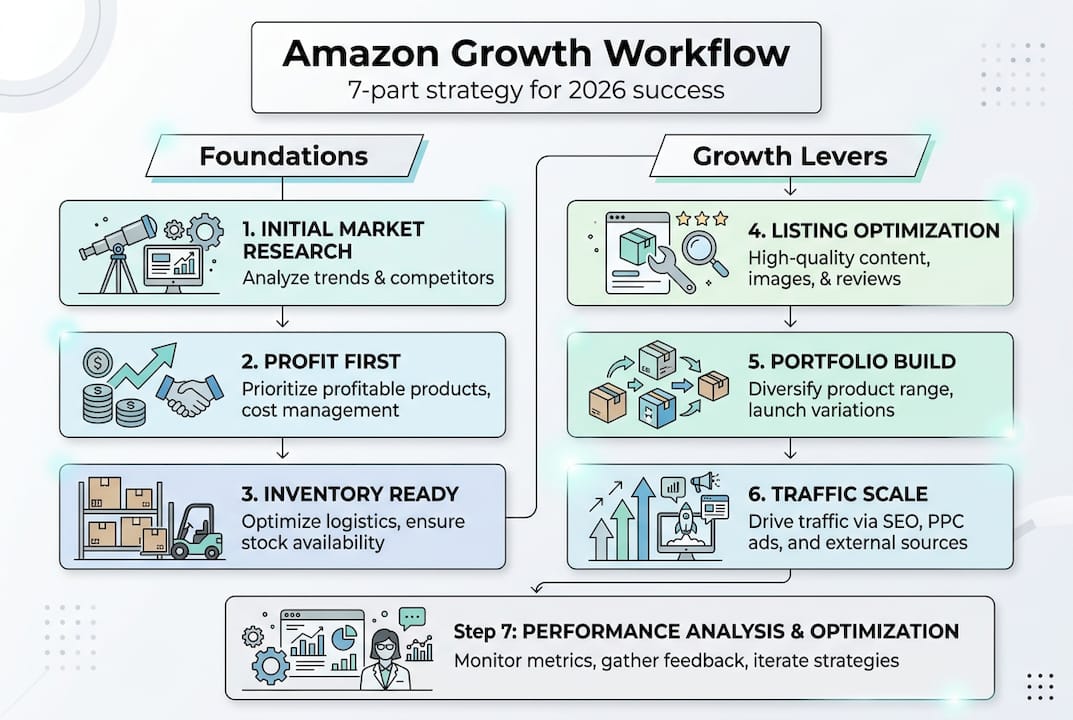
Now that your fulfillment foundation is solid, you can execute the comprehensive workflow that drives profitable growth. This 7-step Amazon growth strategy provides a systematic approach to optimizing every aspect of your Amazon business while maintaining the profit discipline we established earlier. Each step builds on the previous one, creating a reinforcing cycle of improvement.
-
Track profitability at the ASIN level using specialized software that connects to your Seller Central account and calculates true profit after all Amazon fees, advertising costs, and COGS. Review this data weekly to identify which products deserve more investment and which need pricing adjustments or discontinuation.
-
Optimize operations and inventory by implementing just-in-time replenishment strategies that balance stockout risk against storage fees. Use sales velocity data to forecast demand accurately and adjust reorder points seasonally.
-
Structure Amazon PPC management including PPC campaigns with clear separation between branded defense, category targeting, and competitor conquest strategies. Allocate budgets based on campaign profitability, not just ACoS, and ruthlessly eliminate keywords with poor conversion despite acceptable cost metrics.
-
Implement strategic pricing that responds to competitive pressure without racing to the bottom. Use repricing tools that factor in your minimum margin requirements and adjust based on Buy Box probability rather than simply matching the lowest price.
-
Convert listings into high-performing sales assets through A/B testing of images, titles, bullet points, and A+ content, see our account management services. Focus on addressing customer objections revealed in competitor reviews and highlighting differentiation that justifies your price point.
-
Choose the right selling model for each product based on velocity, margins, and competitive dynamics. High-margin items with moderate sales might perform better with FBM to preserve profit, while commodity products need FBA for Buy Box competitiveness.
-
Monitor and protect your brand by setting up automated alerts for listing hijackers, unauthorized sellers, and counterfeit activity. Swift action on intellectual property violations preserves both your margins and customer trust.
Effective Amazon PPC optimization guide implementation requires segmenting your campaigns by intent and performance:
- Branded campaigns with exact match keywords to defend against competitor conquest at minimal cost
- Category broad campaigns for discovery and keyword research, heavily monitored for waste
- High-intent phrase and exact campaigns targeting bottom-funnel searchers ready to purchase
- Product targeting campaigns focusing on competitor ASINs with lower ratings or higher prices
Your Amazon retail strategy explained approach should align pricing decisions with inventory position and competitive landscape. When you have excess inventory approaching long-term storage fees, strategic price reductions that maintain positive margins make more sense than paying storage and tying up capital. Conversely, when you’re the only seller with stock of a popular item, dynamic pricing upward captures the demand premium.
| Selling Model | Ideal Profit Margin | Velocity Requirement | Competitive Intensity |
|---|---|---|---|
| FBA Premium | 40%+ | Medium to High | Low to Medium |
| FBA Competitive | 25-40% | High | High |
| FBM Specialized | 50%+ | Low to Medium | Low |
| Hybrid Flexible | 30-45% | Variable | Medium |
Pro Tip: Create a simple scorecard for each ASIN rating it on profitability, velocity, competitive pressure, and brand alignment. Products scoring high across all dimensions deserve maximum investment, while low scorers need immediate strategic decisions about pricing, promotion, or discontinuation.
Scaling your Amazon brand sustainably with portfolio management and external traffic
Once your core workflow is optimized, sustainable scaling comes from strategic portfolio expansion and traffic diversification. The portfolio approach involves grouping 3-7 SKUs that share supply chains, manufacturing relationships, and target customers. This clustering creates operational efficiencies in inventory management, allows for coordinated marketing campaigns, and enables cross-selling opportunities that increase customer lifetime value.
Dynamic pricing becomes exponentially more powerful when applied across a portfolio rather than individual SKUs. You can strategically price entry-level products more aggressively to capture market share and initial customer relationships, while maintaining premium pricing on complementary or advanced products where you’ve already established trust. This tiered pricing strategy maximizes both acquisition and monetization across the customer journey.
External traffic represents one of the most underutilized growth levers for Amazon sellers in 2026. By driving qualified visitors from social media, content marketing, email lists, or paid ads on other platforms directly to your Amazon listings, you reduce dependence on Amazon’s internal search algorithm and advertising auction. This diversification improves your organic ranking through increased sales velocity while lowering your overall TACoS by generating sales without corresponding Amazon ad spend.
The data shows that 42% of successful sellers use cross-platform strategies with reported cost savings of 40-50% compared to Amazon-only advertising. These sellers build audiences on platforms they control, then strategically direct purchase intent to Amazon where conversion rates are highest. This approach also provides valuable customer data and relationship-building opportunities that Amazon’s platform doesn’t offer.
Comparing single-platform versus multi-channel approaches reveals significant strategic differences:
- Single-platform sellers enjoy operational simplicity and can deeply optimize Amazon-specific tactics but face complete dependence on one marketplace’s policies and algorithm changes
- Multi-channel sellers gain risk diversification and customer data ownership but must manage complexity across platforms and split limited resources
- Hybrid sellers who sell primarily on Amazon but drive external traffic capture the best of both worlds with manageable added complexity
Effective Amazon brand management process requires thinking beyond individual product optimization to portfolio-level strategy. Consider how your product lineup works together to serve different customer needs, price points, and use cases. A well-designed portfolio naturally encourages customers to purchase multiple items, increasing average order value and improving your overall business economics.
Pro Tip: Start external traffic experiments with your highest-margin products that can absorb the learning curve costs. Track the full-funnel metrics including click-through rate from external source, Amazon listing conversion rate, and total cost per acquisition to identify your most profitable traffic channels.
“The most successful Amazon brands in 2026 don’t just optimize their presence on the platform. They build audiences they own and strategically direct that demand to Amazon where it converts most efficiently.”
Enhance your Amazon growth with expert consultancy services
Implementing a comprehensive growth strategy workflow requires significant expertise, time, and continuous optimization that many brand owners struggle to maintain while running their core business. Professional Amazon services can accelerate your results by applying proven frameworks and dedicated resources to every aspect of your marketplace presence. Agile Consultancy specializes in helping sellers navigate exactly these challenges through tailored solutions for account management, advertising optimization, and inventory coordination.
Our Amazon account management service provides comprehensive oversight of your Seller Central operations, from listing optimization and catalog management to performance monitoring. Learn about our analytics & reporting and compliance. We implement the profit-first workflows outlined in this guide while handling the daily tactical execution that keeps your account healthy and growing. Expert Amazon PPC management services apply advanced campaign structures, bid optimization, and keyword research to reduce your TACoS while scaling sales profitably. Our Amazon inventory and FBA management solutions help you navigate 2026’s fulfillment complexities through strategic planning and 3PL coordination. Partnering with specialists who live and breathe Amazon strategy daily lets you focus on product development and business growth while ensuring your marketplace execution remains world-class.
FAQ
What are the essential metrics to monitor before scaling an Amazon business?
Focus on profitability metrics rather than just revenue growth. Track TACoS (Total Advertising Cost of Sales) instead of only ACoS to understand how advertising affects your entire business, not just ad-attributed sales. Monitor ASIN-level profit margins weekly to catch erosion early, and maintain detailed visibility into landed costs including all fees, prep services, and storage charges.
How can sellers comply with Amazon’s new fulfillment requirements in 2026?
Use third-party logistics providers or prep centers to handle product preparation since Amazon discontinued FBA prep services. Implement a hybrid fulfillment strategy combining FBA for fast-moving items, FBM for specialized products, and 3PL partnerships for prep and overflow inventory. Pre-stage inventory outside Amazon’s network to navigate dynamic storage limits and avoid penalty fees.
What are the benefits of managing a product portfolio for Amazon growth?
Grouping 3-7 related SKUs that share supply chains improves inventory efficiency and enables coordinated marketing strategies. Portfolio management allows tiered pricing where entry products attract customers while premium items maximize profit. This approach also facilitates cross-selling opportunities that increase customer lifetime value and overall business stability.
How does external traffic improve Amazon sales performance?
Driving qualified visitors from social media, email marketing, or other platforms to your Amazon listings reduces dependence on Amazon’s internal search algorithm. External traffic improves organic ranking through increased sales velocity while lowering TACoS by generating sales without corresponding Amazon ad spend. Sellers using cross-platform strategies report 40-50% cost savings compared to Amazon-only advertising approaches.
Amazon Growth Agency · Amazon SPN Approved Partner
Agency specialized in growing brands on Amazon through data-driven PPC strategies, conversion-optimized listings, and complete Seller Central account management.