Amazon Retail Strategy: Building Profitable Market Presence
Author: Adi Malai | | Category: Blog | Reading time: 11 min

Struggling to maintain profits on Amazon while rivals seem to adapt faster than you can react? Clear fundamentals separate top sellers from those left guessing at every algorithm shift. Every e-commerce brand manager and Amazon seller needs a unified approach built on customer-centric operations, competitive pricing, and operational excellence. This guide clarifies the strategy models, campaign tactics, and brand protection steps proven to deliver lasting growth amid fierce marketplace competition.
Table of Contents
- Defining Amazon Retail Strategy Fundamentals
- Key Models: Vendor Central Vs. Seller Central
- Optimizing PPC Campaigns For Higher ROI
- Brand Protection And Marketplace Risks
- Scaling Profitably Amid Amazon Competition
Key Takeaways
| Point | Details |
|---|---|
| Understand Amazon’s Core Pillars | Successful selling requires a focus on customer needs, competitive pricing, and efficient delivery to optimize the shopping experience. |
| Choose the Right Business Model | Selecting between Vendor Central and Seller Central is crucial; understand how each model impacts control, margins, and operations. |
| Prioritize Data-Driven Decisions | Utilize metrics to guide your inventory management, pricing strategies, and marketing efforts for ongoing improvement and growth. |
| Strengthen Brand Protection | Actively monitor for threats like counterfeiters and hijackers; implement protective measures quickly to maintain brand integrity and customer trust. |
Defining Amazon Retail Strategy Fundamentals
Your Amazon retail strategy is the blueprint for building sustainable profits on the world’s largest e-commerce marketplace. Without clear fundamentals, you’re competing blind, reacting to algorithm changes instead of directing them.
Amazon’s own success stems from three core pillars that Amazon sellers must understand and replicate. Customer-centric operations mean every decision flows from what buyers actually want, not what’s easiest for you. Competitive pricing combined with swift delivery creates the frictionless experience customers expect. Strategic analysis of business models shows that vertical integration and technology leverage directly impact operational efficiency and market resilience.
Your strategy must address these core elements:
- Product Selection Strategy: Offer the right products to your target audience, not everything under the sun
- Pricing Architecture: Balance competitiveness with profitability; undercutting destroys margin
- Operational Excellence: Fast fulfillment, accurate inventory, and zero listing defects are non-negotiable
- Customer Experience: Reviews, ratings, and response times directly drive visibility and conversions
- Data-Driven Decision Making: Let metrics guide inventory, pricing, and marketing spend
Amazon’s evolution from bookstore to global marketplace happened because they continuously adapted to market conditions while maintaining customer obsession. Your strategy should do the same.
Your retail fundamentals determine whether you’re building a sustainable brand or chasing vanishing margins.
Many sellers confuse tactics with strategy. Running Amazon PPC management including PPC campaigns is a tactic. Understanding how Amazon’s marketing strategies combine technology, pricing, and product selection into a unified ecosystem-that’s strategic thinking.
Your Amazon retail strategy answers these critical questions:
- Who is your ideal customer, and what problems do your products solve for them?
- How will you price competitively while maintaining healthy margins?
- What operational systems ensure consistent, fast fulfillment?
- How will you leverage data to optimize performance continuously?
- How do you protect your brand from hijacking and counterfeit threats?
Without answers to these questions, you’re gambling. With them, you’re building.
Pro tip: Document your answers to all five questions in a single strategy document, then review and refine them quarterly as market conditions shift-this prevents reactive decision-making when algorithm changes hit.
Here’s a summary of how each Amazon retail strategy fundamental impacts long-term business growth:
| Fundamental Area | Impact on Growth | Common Pitfall |
|---|---|---|
| Product Selection | Drives repeat purchases and loyalty | Chasing every trend |
| Pricing Architecture | Sustains healthy margins | Entering price wars |
| Operational Excellence | Enables scaling without errors | Overreliance on manual work |
| Customer Experience | Increases retention and reviews | Slow response to complaints |
| Data-Driven Decisions | Identifies new growth opportunities | Ignoring actionable metrics |
Key Models: Vendor Central vs. Seller Central
Amazon offers two fundamentally different business models, and choosing wrong costs you thousands in lost margin or operational complexity. Understanding the distinction between Vendor Central and Seller Central is your first critical decision.
Vendor Central positions you as a wholesale supplier to Amazon itself. Amazon purchases your inventory upfront, owns the stock, and controls pricing and promotion. You receive a wholesale purchase order, not individual sales data.
Seller Central keeps you in direct control. You own inventory, set prices, manage customer relationships, and keep significantly more profit per unit. Amazon takes a commission, but you own the relationship.

Here’s what separates them:
| Factor | Vendor Central | Seller Central |
|---|---|---|
| Inventory Ownership | Amazon owns it | You own it |
| Pricing Control | Amazon sets it | You set it |
| Profit Margin | Lower (wholesale) | Higher (retail) |
| Customer Data | Limited access | Full access |
| Fulfillment | Vendor Fulfilled Network | FBA or FBM |
| Risk Level | Lower (Amazon buys stock) | Higher (you manage inventory) |
Vendor Central works best if you manufacture at scale and want predictable wholesale orders without managing Amazon logistics yourself. Think large CPG brands with manufacturing capacity.
Seller Central works best for brand owners, resellers, and anyone wanting customer-centric operations and direct control over their Amazon presence. You capture customer feedback, build brand loyalty, and adjust strategy based on real market data.
Vendor Central trades margin for convenience; Seller Central trades operational complexity for profit and control.
Most serious brand builders choose Seller Central because it allows you to build authentic brand relationships and scale faster through strategic pricing and marketing.
Consider these trade-offs:
- Vendor Central: Passive income, no fulfillment headaches, but Amazon controls your brand narrative
- Seller Central: Active management required, but you own the data, metrics, and customer relationships
Your choice shapes everything downstream-your ability to run PPC campaigns, adjust pricing, negotiate placement, and protect your brand from hijacking.
Pro tip: If you’re just starting out, begin with Seller Central to learn how your products perform and build customer data; many successful brands later transition to Vendor Central once they’ve proven wholesale viability.
Optimizing PPC Campaigns for Higher ROI
Your PPC budget bleeds away if you’re not ruthless about optimization. Most Amazon sellers waste 30-40% of ad spend on clicks that never convert. The difference between profitable and failing campaigns comes down to continuous refinement.
PPC optimization starts with understanding your baseline metrics. ACOS (Advertising Cost of Sale), ROAS (Return on Ad Spend), and CTR (Click-Through Rate) tell you exactly where money is being wasted.
Your optimization strategy rests on three pillars:
- Keyword research and targeting: Find high-intent keywords with lower competition, not just high-volume terms
- Negative keyword management: Eliminate search terms burning budget without converting
- Bid optimization: Adjust bids based on performance, not guesswork
Thorough keyword research and strategic bid management directly impact your bottom line. Start by separating automatic and manual campaigns-automatic campaigns reveal what customers are actually searching for, manual campaigns let you control exactly which keywords you target.
Negative keywords are your secret weapon. A single irrelevant search term can drain hundreds monthly. Review your search term reports weekly, identify non-converters, and add them as negatives immediately.
Every dollar in wasted ad spend is a dollar that could have gone to brand building or margin improvement.
Bid optimization happens in layers. High-performing keywords deserve higher bids-they convert, so paying more still maintains healthy ACOS. Underperformers need aggressive bid reductions or removal entirely.
Implement this optimization cycle:
- Run campaigns for 2 weeks, collect performance data
- Analyze which keywords drive conversions at target ACOS
- Increase bids on winners by 10-15%
- Decrease bids on underperformers by 20-30%
- Add negative keywords from low-performing search terms
- Refresh ad copy if CTR drops below category benchmarks
- Repeat weekly
Most sellers optimize monthly-by then, they’ve wasted thousands. Weekly optimization catches waste immediately.
Your ad copy matters as much as targeting. Weak copy kills conversion rates even when keywords are perfect. Test variations focused on benefits, not features.
Pro tip: Set up automated rules in Amazon Advertising to pause keywords with ACOS 50% higher than your target daily; this prevents budget bleed while you sleep and catches underperformers before they drain significant spend.
Brand Protection and Marketplace Risks
Your Amazon brand is under constant attack. Counterfeiters, hijackers, and unauthorized resellers treat your listings as free real estate. Without active protection, you’ll wake up to fake inventory, stolen reviews, and destroyed brand reputation.
The marketplace risks are real and evolving. Counterfeit products damage customer trust permanently. Account hijacking puts fake sellers in control of your inventory. Unauthorized resellers undercut your pricing and dilute brand positioning. Intellectual property theft chips away at competitive advantage.
Amazon itself deploys defenses, but you can’t rely on them alone. Advanced AI and machine learning detect infringing listings proactively, yet bad actors evolve faster than detection systems catch them.
The risks you face include:
- Account hijacking: Attackers gain control of your seller account and change banking details
- Listing hijacking: Competitors add their inventory to your active listings
- Counterfeit knockoffs: Fake versions flood your bestselling products
- Review manipulation: Fraudulent reviews tank your conversion rates
- Pricing warfare: Unauthorized resellers undercut aggressively, destroying margins
- Data breaches: Customer information leaks expose you to legal liability
Marketplace risks compound daily-what starts as one hijacked listing becomes a brand crisis within weeks.
Counterfeit products, unauthorized resellers, and intellectual property risks require vigilant monitoring and rapid response. Passive monitoring costs you market share. Active protection costs time and resources, but saves your business.
Implement these protection layers:
- Enable Brand Registry immediately-it unlocks Enhanced Brand Content and reporting tools
- Monitor your listings daily for hijackers and fake variants
- Set up price monitoring alerts to catch unauthorized resellers
- File takedown requests within 24 hours of finding counterfeits
- Document everything-screenshots, seller IDs, product differences
- Work with Amazon Seller Support on repeat violators
- Consider hiring brand protection services for high-value products
Your response speed determines damage. A hijacked listing left unaddressed for one week causes weeks of recovery work. A hijack caught within hours gets resolved in days.
Brand protection isn’t a one-time setup. It’s an ongoing operational requirement, like inventory management or customer service.
Pro tip: Subscribe to listing monitoring tools that alert you hourly for new sellers on your listings, account login attempts, and pricing drops below your minimum threshold-catching threats immediately prevents them from causing lasting damage.
To clarify the key risks and suggested mitigation measures for Amazon brand protection, see this reference table:
| Marketplace Risk | Potential Consequence | Preventive Measure |
|---|---|---|
| Counterfeit Products | Loss of buyer trust, revenue erosion | Enroll in Brand Registry, report fakes |
| Account Hijacking | Stolen funds, loss of control | Enable two-factor authentication |
| Listing Hijacking | Poor reviews, price instability | Monitor listings daily, act quickly |
| Review Manipulation | Decline in conversion rates | Report suspicious activity to Amazon |
| Unauthorized Resellers | Margin loss, brand dilution | Set up price and seller alerts |
Scaling Profitably Amid Amazon Competition
Scaling fast kills more Amazon businesses than scaling slowly ever will. Adding SKUs, expanding into new categories, or launching new brand lines sounds smart until your margins collapse under operational weight.
Profitable scaling requires strategic discipline. You can’t just increase volume and hope margins follow-they won’t. Costs rise faster than revenue when systems aren’t built to handle growth.
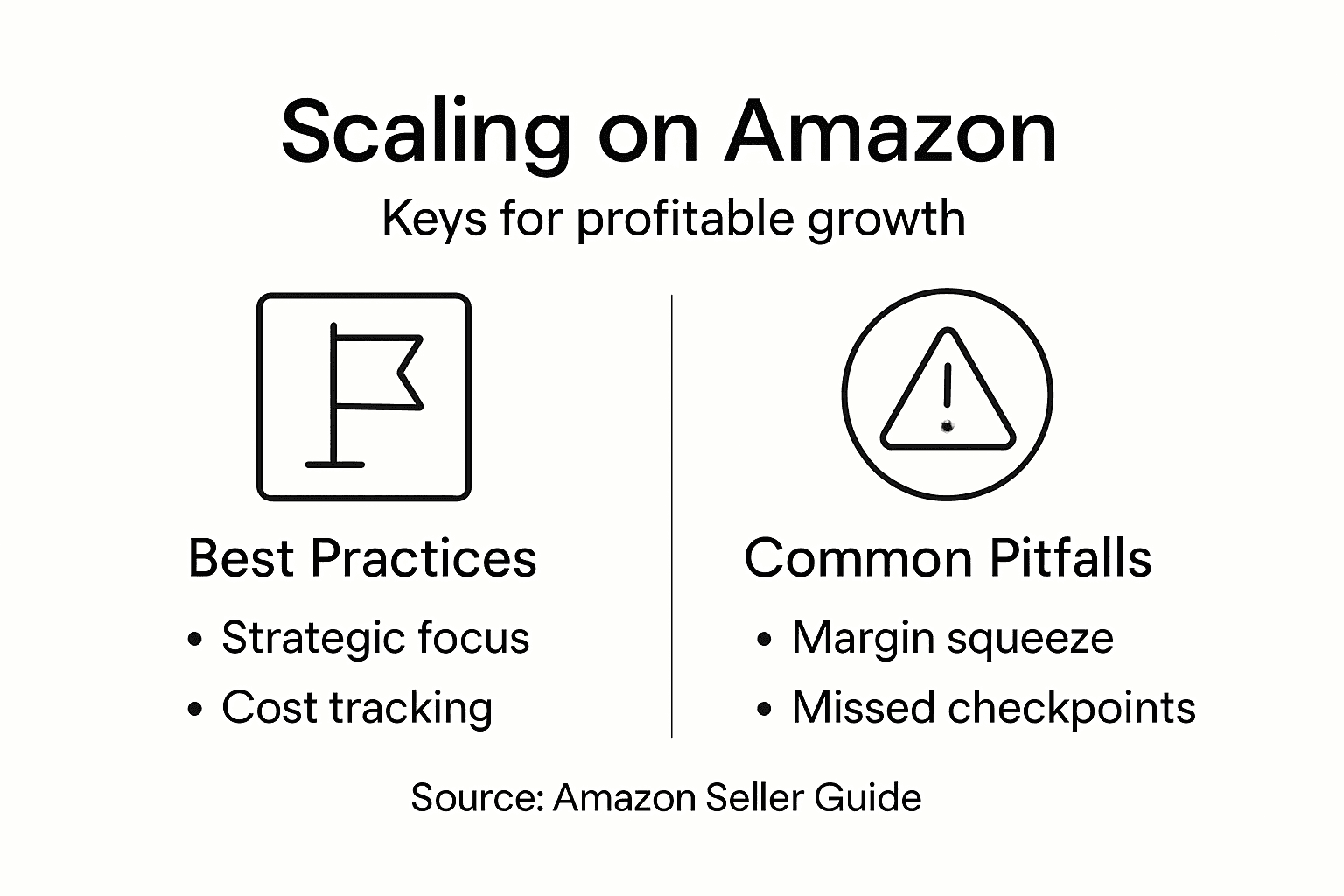
Amazon’s scaling strategy emphasizes timing, leadership alignment, and infrastructure investment to sustain profitable expansion. You need the same foundation before you accelerate.
Scaling profitably means:
- Systems over speed: Build processes that work at 2x your current volume before you reach it
- Margin awareness: Track unit economics obsessively as you scale; a declining margin per unit destroys profitability
- Operational leverage: Automate what repeats; manual work doesn’t scale
- Strategic focus: Expand into adjacent categories only after dominating your core
- Cost discipline: Every operational expense should scale proportionally to revenue, not exponentially
Most sellers make one critical mistake: they treat new product launches as independent ventures. In reality, they compete for your limited time, capital, and operational bandwidth.
Scaling profitably means growing slower than competitors while maintaining higher margins-that’s the real competitive edge.
Amazon integrates business units tightly to maintain strategic coherence while scaling, leveraging technology and operational excellence across the organization. You need similar coordination between inventory management, PPC campaigns, fulfillment, and customer service.
Implement these scaling checkpoints before expanding:
- Your core product line maintains consistent 30%+ net margins
- You have 60+ days of inventory buffer for demand swings
- PPC campaigns run profitably without constant management
- Customer service response time stays under 24 hours
- Your fulfillment process handles 3x current volume without breaking
- Financial systems track unit economics by product and campaign
Skip any checkpoint, and scaling becomes chaos. Your margins compress, customer satisfaction drops, and you’re suddenly understaffed fighting fires instead of growing strategically.
Focus on what Amazon does best: leverage existing infrastructure across new products. Add complementary SKUs to existing listings, not entirely new categories. Reuse your PPC learnings, fulfillment expertise, and customer data.
Pro tip: Before launching any new product, calculate the true cost including platform fees, fulfillment, PPC, customer acquisition, and returns; if net margin drops below your core products, the launch destroys overall profitability even if individual unit sales look strong.
Build a Winning Amazon Retail Strategy with Expert Support
The challenges of managing a profitable Amazon presence demand more than just basic tactics. With complexities like optimizing PPC campaigns, protecting your brand from hijacking, and choosing the right Seller Central strategy, many sellers find their growth stalling or margins shrinking. This article highlights core fundamentals such as operational excellence and data-driven decision making that are absolutely critical to long-term success. If you are ready to take control of your Amazon business, increase sales efficiently, and defend your brand identity against common marketplace risks, expert guidance is essential.
Discover how Agile Consultancy offers tailored solutions for brands and sellers aiming to master their Amazon Seller Central accounts. Benefit from free audits to identify hidden potential, data-backed PPC optimization to reduce wasted ad spend, and ongoing monitoring that protects your listings from counterfeiters and hijackers. Don’t let operational complexity hold back your growth-partner with specialists who understand Amazon’s competitive landscape and can build a sustainable, profitable market presence for your brand. Visit Agile Consultancy now to start transforming your Amazon retail strategy.
Frequently Asked Questions
What are the core pillars of an effective Amazon retail strategy?
An effective Amazon retail strategy revolves around three core pillars: customer-centric operations, competitive pricing, and swift delivery. These pillars help create a frictionless shopping experience for customers.
How can I optimize my product selection on Amazon?
To optimize your product selection, focus on offering the right products that meet the needs of your target audience. Avoid the temptation to chase every trend and instead prioritize quality over quantity.
What steps can I take to protect my brand on Amazon?
You can protect your brand by enrolling in Brand Registry, monitoring your listings daily, and quickly addressing any unauthorized sellers or counterfeit products. Implementing these strategies helps maintain your brand’s reputation and customer trust.
How should I approach PPC campaign optimization on Amazon?
Optimize your PPC campaigns by conducting thorough keyword research, managing negative keywords to eliminate unproductive terms, and regularly adjusting bids based on performance. Continuous refinement is essential to improve your campaigns and reduce wasted ad spend.
Amazon Growth Agency - Listed in the Amazon Service Provider Network
Agency specialized in growing brands on Amazon through data-driven PPC strategies, conversion-optimized listings, and complete Seller Central account management.