Amazon sales growth guide 2026: proven seller strategies
Author: Adi Malai | Category: Blog | Reading time: 8 min

Growing your Amazon sales in 2026 feels impossible when you’re battling algorithm changes, fierce competition, and shrinking visibility. You optimize listings, run ads, tweak pricing, yet sales stagnate or decline. This guide delivers proven, data-backed strategies to help Amazon sellers break through growth plateaus and build sustainable revenue momentum in the evolving marketplace.
Table of Contents
- Prepare Your Amazon Store For Growth: Fundamentals And Research
- Execute Proven Tactics: Advertising, Listing Optimization, And Inventory Management
- Verify And Adapt: Monitoring Metrics And Optimizing For Emerging Trends
- Need Expert Help To Grow Your Amazon Sales In 2026?
- FAQ
Key takeaways
| Point | Details |
|---|---|
| Optimize listing fundamentals | High-quality images, compelling titles, and bullet points drive conversion rate improvements |
| Leverage advertising strategically | Sponsored Products and Brands campaigns increase visibility and sales by 20-30% on average |
| Win the Buy Box consistently | FBA fulfillment, competitive pricing, and strong seller metrics are essential for Buy Box dominance |
| Monitor critical performance metrics | Track conversion rate, CTR, sales velocity, and reviews to adapt strategies quickly |
| Prepare for mobile and voice search | Over 60% of traffic comes from mobile devices, requiring mobile-optimized and conversational listings |
Prepare your Amazon store for growth: fundamentals and research
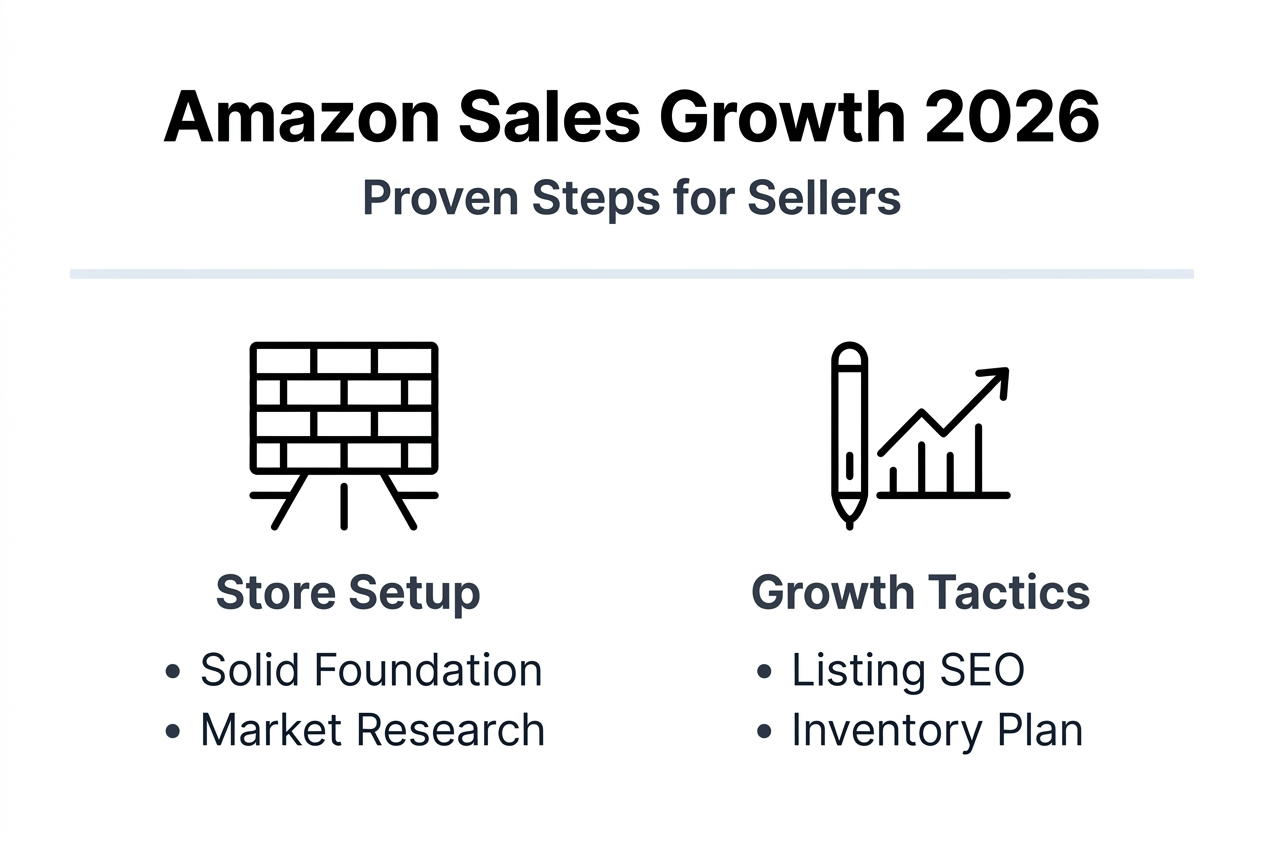
Before scaling your Amazon business, you need a rock-solid foundation. Sellers who rush into advertising without fixing basic listing issues waste budgets on traffic that never converts. Start by auditing your product listings, see our account management services for content quality, image clarity, and keyword relevance.
Fulfillment by Amazon (FBA) combined with competitive pricing results in higher Buy Box win rates. FBA signals trust to customers and Amazon’s algorithm, dramatically improving your chances of winning that coveted Buy Box placement. If you’re still using FBM for your main products, switching to FBA should be your first move.
Research what customers actually ask before they buy. Dive into competitor Q&A sections, read negative reviews on similar products, and identify pain points your listing can address directly. This customer-centric approach transforms generic listings into conversion machines that answer objections before they arise.
Competitive pricing isn’t about being the cheapest, it’s about finding the sweet spot where profit margins meet market expectations. Use repricing tools to monitor competitor prices in real time and adjust automatically. Small price differences make huge impacts on Buy Box share and overall sales velocity.
Prioritizing Amazon as a major sales channel leads to proactive decision making and quicker adaptation to algorithm changes and market trends. Sellers who treat Amazon as a side project miss opportunities to capitalize on traffic surges and seasonal trends. If you’re serious about growth in 2026, commit resources and attention to your Amazon presence. Learn more about building seller success with a structured approach.
Pro Tip: Create a simple spreadsheet tracking your top 10 competitors’ prices, ratings, and review counts. Update it weekly to spot trends and opportunities before your competition does.
Key preparation steps include:
- Audit all product images for quality, zoom capability, and lifestyle context
- Rewrite titles to include primary keywords within the first 80 characters
- Update bullet points to address customer questions found in competitor reviews
- Switch to FBA for products where margins support fulfillment fees
- Set up automated repricing rules based on Buy Box eligibility thresholds
Understanding how the marketplace operates helps you make strategic decisions about inventory, pricing, and product selection. Find more optimization tips covering the full spectrum of sales growth tactics.
Execute proven tactics: advertising, listing optimization, and inventory management
With fundamentals in place, it’s time to execute growth strategies that compound over time. Sponsored Products and Brands campaigns see a 20-30% increase in sales volume for sellers who manage them strategically. Start small, test keywords methodically, and scale what works.
Launching effective ad campaigns requires a structured approach:
- Begin with automatic campaigns to discover which search terms convert
- Mine search term reports weekly for high-performing keywords
- Move winning keywords into manual campaigns with optimized bids
- Create Sponsored Brands campaigns for branded traffic and awareness
- Set up Product Targeting campaigns to appear on competitor listings
- Monitor ACoS daily during the first two weeks, then weekly
Your listing optimization directly impacts how well paid traffic converts. Conversion rate is the main signal for Amazon’s A10 algorithm. Every visitor who buys sends a powerful relevance signal that boosts your organic ranking, creating a virtuous cycle of traffic and sales.
Focus listing optimization efforts on these high-impact elements:
- Main image: White background, product fills 85% of frame, professional lighting
- Title: Front-load primary keyword, include key features, stay under 200 characters
- Bullet points: Lead with benefits, use specific measurements, address objections
- A+ Content: Add comparison charts, lifestyle images, and detailed feature explanations
- Backend keywords: Fill all available character space with synonyms and variations
Inventory management makes or breaks sales momentum. Stockouts destroy ranking because Amazon’s algorithm interprets them as product unavailability, tanking your hard-earned visibility. Use inventory planning tools that forecast demand based on sales velocity, lead times, and seasonal patterns.
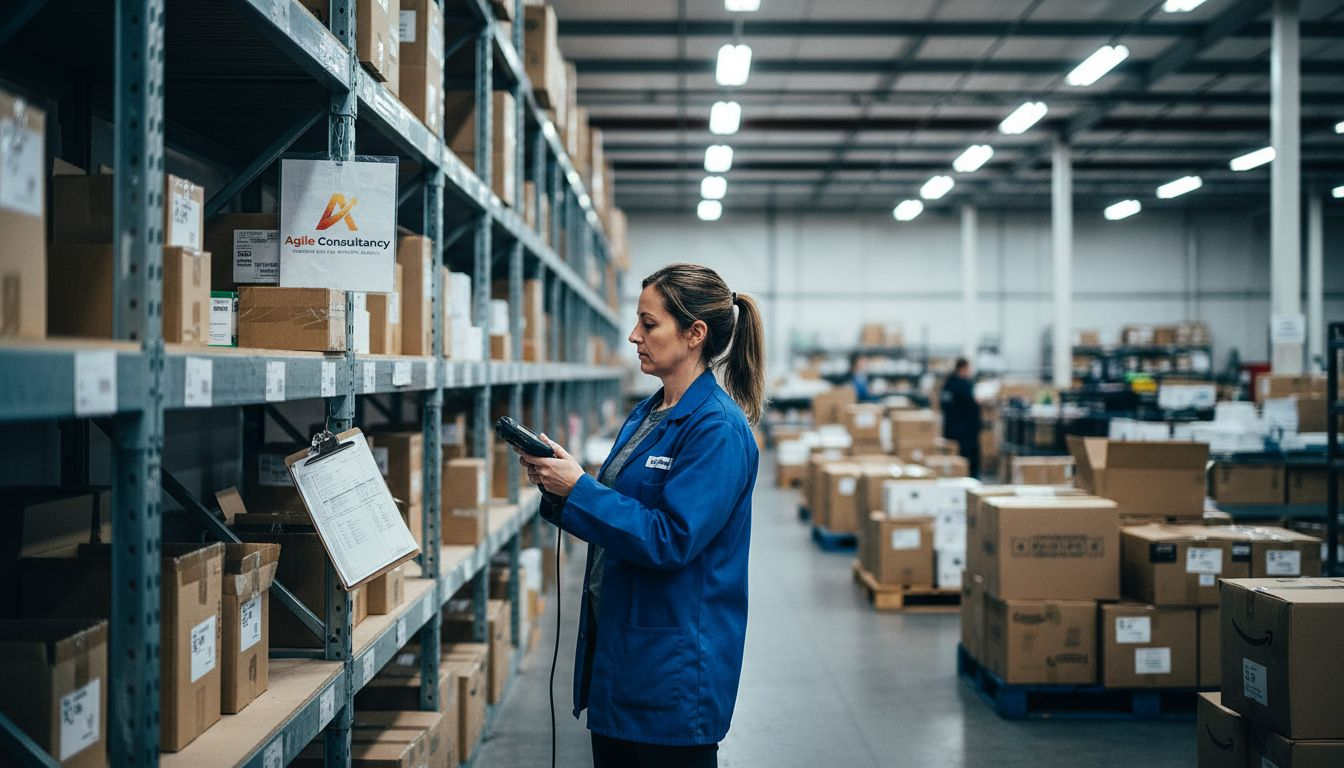
Pro Tip: Set reorder points at 45 days of inventory coverage instead of waiting until you hit 30 days. This buffer protects against supplier delays and gives you negotiating power for better terms on larger orders.
Pricing strategy in 2026 requires continuous adjustment. Static pricing leaves money on the table during high-demand periods and loses sales during slow periods. Implement dynamic repricing that responds to competitor moves, inventory levels, and time of day.
| Advertising Type | Best Use Case | Typical ACoS Range |
|---|---|---|
| Sponsored Products | Direct sales and conversions | 15-30% |
| Sponsored Brands | Brand awareness and traffic | 20-35% |
| Sponsored Display | Retargeting and remarketing | 25-40% |
| Product Targeting | Conquering competitor listings | 18-33% |
Explore comprehensive advertising strategies and understand the role of SEO in driving organic visibility. Study sponsored ads benefits and current ranking factors to refine your approach.
Verify and adapt: monitoring metrics and optimizing for emerging trends
Execution without measurement wastes resources on ineffective tactics. Track your critical performance indicators weekly to catch problems before they crater sales. Conversion rate, CTR, sales velocity, and review ratings tell you whether your strategies are working or failing.
CTR from search results is a key factor in determining listing relevance. Low CTR signals that your title and main image aren’t compelling enough to earn clicks, which eventually tanks your organic ranking. If CTR drops below 0.3%, redesign your main image and rewrite your title immediately.
Mobile optimization isn’t optional anymore. Over 60% of Amazon traffic comes from mobile devices, meaning your listings must look perfect on small screens. Test every listing element on your smartphone: images must be clear at thumbnail size, titles must communicate value in the first 50 characters, and bullet points must be scannable.
Voice search continues growing in 2026 as smart speakers become ubiquitous shopping tools. Optimize for voice by incorporating natural language and question-based phrases into your backend keywords and content. Instead of “wireless headphones bluetooth”, include “what are the best wireless headphones for running” in your keyword strategy.
Key metrics to monitor weekly:
- Conversion rate by traffic source to identify underperforming channels
- Click-through rate from search results to gauge title and image effectiveness
- Sales velocity trends to predict inventory needs and catch ranking drops early
- Review velocity and ratings to protect brand reputation
- Buy Box percentage to ensure you’re winning the majority of sales opportunities
Amazon’s algorithm evolves constantly, and sellers who adapt fastest win. When you notice sudden ranking drops or traffic changes, investigate immediately. Check if competitors launched new products, adjusted pricing, or improved listings. The sellers who react within 48 hours minimize revenue loss.
| Buy Box Factor | Impact Level | Optimization Priority |
|---|---|---|
| Fulfillment method | Very High | Switch to FBA for main products |
| Competitive pricing | Very High | Implement automated repricing |
| Seller rating | High | Maintain above 95% positive feedback |
| Order defect rate | High | Keep below 1% through quality control |
| Inventory depth | Medium | Maintain 60+ days stock on hand |
Develop a comprehensive retail strategy that aligns with marketplace dynamics. Consider the benefits of working with consultants who specialize in Amazon growth. Review mobile shopping statistics and understand CTR importance for ranking success.
Pro Tip: Create a simple dashboard in Google Sheets that pulls key metrics from Amazon’s API daily. Set up conditional formatting to highlight metrics that drop below thresholds, giving you early warning signals before problems escalate.
Need expert help to grow your Amazon sales in 2026?
Implementing these strategies takes time, expertise, and constant attention to detail. Many sellers struggle to balance inventory management, advertising optimization, and listing improvements while running other parts of their business.
Professional Amazon management services handle the heavy lifting of Amazon PPC management including PPC campaigns, listing optimization, and performance monitoring. Learn about our analytics & reporting. At Agile Consultancy, we specialize in data-driven strategies that increase visibility while reducing advertising costs. Our team stays ahead of algorithm changes and marketplace trends so you don’t have to.
Brand protection services safeguard your reputation by monitoring for hijackers, unauthorized sellers, and counterfeit listings. In the fast-moving 2026 Amazon landscape, protecting what you’ve built is just as important as growing sales. Explore our comprehensive Amazon seller services designed for brands ready to scale efficiently. Learn more about how consultants drive marketplace growth and accelerate your success.
FAQ
How can I improve my Amazon listing’s conversion rate?
Enhance product images with professional photography showing multiple angles, lifestyle contexts, and detail shots. Write clear titles that front-load primary keywords and main benefits within the first 80 characters. Update bullet points to directly address common customer questions and pain points found in competitor reviews and Q&A sections.
What are the main factors to win the Amazon Buy Box in 2026?
FBA fulfillment dramatically improves Buy Box win rates by signaling reliability and fast shipping to Amazon’s algorithm. Competitive pricing within 5% of the lowest offer keeps you eligible while protecting margins. Strong seller metrics including ratings above 95%, order defect rates below 1%, and consistent inventory availability round out the winning formula.
Why is monitoring click-through rate (CTR) important for Amazon sellers?
CTR signals listing relevance to Amazon’s A10 algorithm, directly impacting your organic search ranking. When shoppers consistently skip your listing in search results, Amazon interprets this as irrelevance and lowers your visibility over time. Higher CTR from compelling titles and images boosts organic ranking, creating more traffic and sales opportunities without additional ad spend.
How can Amazon sellers prepare for the rise of voice search?
Include natural language and question-based phrases in backend keywords and listing content. Focus on long-tail, conversational search terms like “what are the best” or “how do I choose” instead of short generic keywords. Structure bullet points and A+ Content to answer common questions directly, as voice assistants often pull featured snippet-style responses from detailed product information.
Amazon Growth Agency · Amazon SPN Approved Partner
Agency specialized in growing brands on Amazon through data-driven PPC strategies, conversion-optimized listings, and complete Seller Central account management.