Why scale on Amazon marketplace for e-commerce in 2026
Author: Adi Malai | Category: Blog | Reading time: 10 min

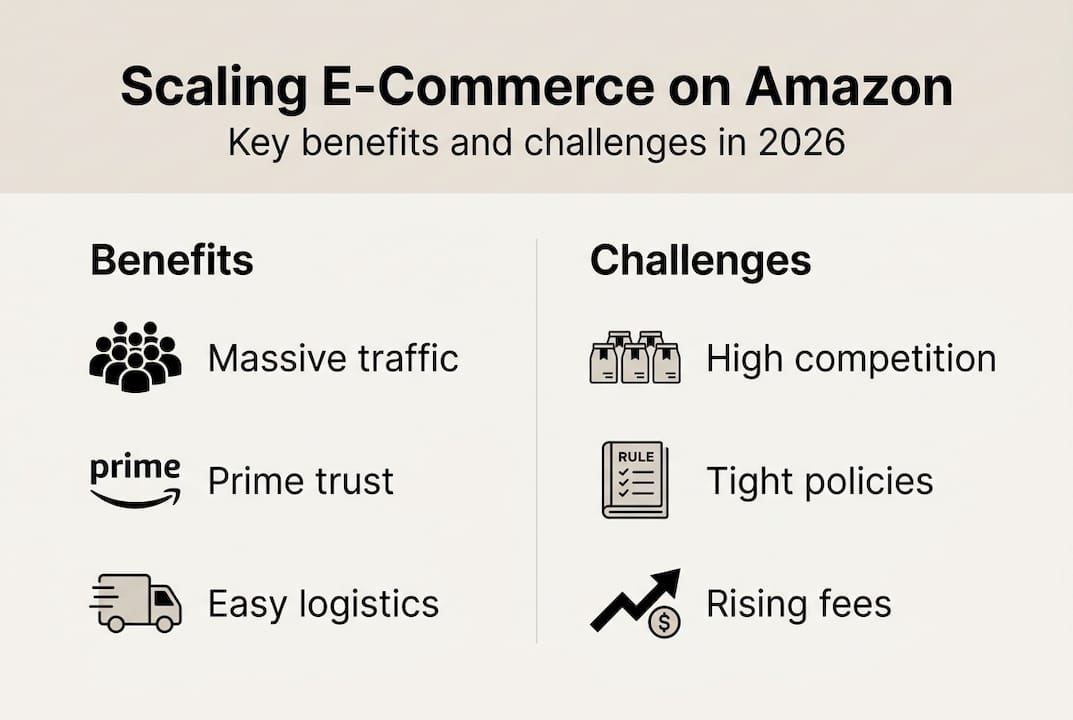
Amazon attracts over 3 billion monthly visits, yet only 7.3% of 4.2 million sellers hit $100K net profit, highlighting the challenge of scaling successfully on Amazon. The opportunity is immense but requires strategic knowledge and operational precision to capture. Scaling effectively on Amazon means understanding both the platform’s unique advantages and the pitfalls that trap most sellers. This guide explains why scaling on Amazon is valuable and how to approach it to maximize success while avoiding common mistakes that derail growth.
Table of Contents
- The Benefits Of Scaling On Amazon Marketplace
- Understanding The Challenges And Risks Of Scaling On Amazon
- Expert Strategies To Scale Effectively On Amazon In 2026
- Why Diversify Beyond Amazon: Comparing Amazon With Walmart And Shopify
- Grow Your Amazon Business With Expert Support
- Frequently Asked Questions About Scaling On Amazon
Key takeaways
| Point | Details |
|---|---|
| Massive traffic advantage | Amazon’s 3+ billion monthly visits and Prime benefits drive rapid growth potential for optimized brands. |
| Data-driven optimization | Top sellers focus on portfolio management, hybrid fulfillment, and weekly optimization routines. |
| Scaling risks | Rising fees, operational complexity, and cash flow challenges can compress margins if not managed. |
| Agency partnerships | Expert support for PPC, audits, and brand protection helps mitigate scaling pitfalls effectively. |
| Diversification strategy | Multi-channel presence beyond Amazon protects against marketplace volatility and fee increases. |
The benefits of scaling on Amazon marketplace
Amazon’s ecosystem offers unmatched demand capture for brands ready to scale. The platform’s 3+ billion monthly visits represent a customer base actively searching for products, eliminating the cold traffic problem that plagues most e-commerce channels. Prime eligibility creates a powerful conversion flywheel where fast, free shipping drives higher purchase rates, better reviews, and repeat customers. This Amazon brand management ecosystem enables rapid sales growth for brands with optimized listings and products.
Organic growth compounds through listing optimization and advanced advertising strategies. When you optimize product titles, bullet points, and backend keywords, Amazon’s A9 algorithm rewards you with higher organic rankings. Pair this with strategic Amazon PPC management including PPC campaigns, and you create a compounding effect where paid ads drive initial sales velocity, boosting organic rankings, which then reduces your advertising dependency over time. High traffic volume facilitates faster sales velocity and brand recognition compared to standalone e-commerce stores that must build audiences from scratch.
The benefits extend beyond pure traffic volume:
- Prime badge eligibility increases conversion rates by 30 to 50% compared to non-Prime listings
- Amazon’s fulfillment network handles logistics, freeing you to focus on product development and marketing
- Built-in customer trust from Amazon’s brand reduces the friction in first-time purchases
- Access to Amazon’s advertising ecosystem including Sponsored Products, Brands, Display, and DSP for full-funnel marketing
Leveraging Amazon’s ecosystem means tapping into infrastructure that would cost millions to build independently, from warehousing to customer service to payment processing.
Critical to success is understanding that Amazon rewards sellers who master its specific playbook. The platform’s algorithm favors products with strong sales history, positive reviews, and competitive pricing. Brands that invest in proven seller strategies see exponential returns as their listings gain momentum. The compounding nature of Amazon’s ranking system means early optimization efforts pay dividends for months or years.
Understanding the challenges and risks of scaling on Amazon
Scaling on Amazon comes with significant operational and financial challenges that catch unprepared sellers off guard. Scaling too fast causes cash flow and stockout issues while rising fees and competition pressure margins. FBA fee increases and CPC cost inflation have compressed profit margins across categories, with average advertising costs rising 3.6% year over year in 2026. What looked like a profitable product at launch can become break-even or negative as competition intensifies and Amazon adjusts its fee structure.
Over-dependence on FBA poses risks if disruptions occur. Sellers who rely exclusively on Fulfillment by Amazon face vulnerability to warehouse closures, inventory limits, and policy changes that can halt sales overnight. The 2025 holiday season saw widespread FBA capacity constraints that left many sellers unable to restock their best products during peak demand. Diversifying fulfillment methods protects against these single points of failure.
Fast scaling strains cash flow and inventory management in ways that surprise even experienced operators:
- Inventory purchases must happen 60 to 90 days before sales, tying up capital
- Amazon’s payment cycle holds funds for 14 days, creating cash gaps
- Rapid growth requires proportional increases in inventory investment, often outpacing available capital
- Stockouts damage organic rankings and can take weeks to recover from
Ignoring reimbursement audits leaves money on the table. Amazon’s fulfillment network makes mistakes, from lost inventory to damaged units to incorrect customer refunds. Sellers who don’t systematically audit these issues forfeit thousands in legitimate reimbursements. The complexity of tracking these across multiple SKUs and fulfillment centers makes it easy to miss.
Pro Tip: Set up automated alerts for inventory levels at 30 days and 15 days of stock remaining. This buffer gives you time to manufacture and ship replenishments before stockouts damage your rankings and sales velocity.
Operational excellence separates successful scaling from failure. Brands must master inventory forecasting, understand Amazon’s complex fee structure, monitor competitor pricing, manage customer reviews, protect against hijackers, and optimize advertising daily. Many sellers underestimate this operational load and find themselves overwhelmed as SKU counts and order volumes grow. Understanding common Amazon seller mistakes helps you avoid these pitfalls before they become expensive lessons.

Expert strategies to scale effectively on Amazon in 2026
Successful sellers deploy specific tactics that drive sustainable scaling while managing risks. 7-figure sellers typically build portfolios of 3-7 SKUs and use hybrid fulfillment along with data-driven optimization. Portfolio building spreads risk across multiple products so that seasonal fluctuations or competitive pressure on one SKU doesn’t sink your entire business. The sweet spot of 3 to 7 SKUs provides diversification without spreading resources too thin across inventory and advertising.
Adopt hybrid fulfillment models that combine FBA, FBM, and third-party logistics to reduce disruption risk. Use FBA for your core fast-moving products where Prime eligibility matters most. Handle oversized or slow-moving items through Fulfillment by Merchant to avoid long-term storage fees. Partner with 3PL providers for backup capacity during peak seasons or FBA restrictions. This approach gives you flexibility and protects against any single fulfillment channel becoming a bottleneck.
Partner with agencies for PPC, DSP full-funnel marketing, and operational audits. Specialized agencies bring expertise in Amazon’s constantly evolving advertising platform, from campaign structure to bid optimization to creative testing. They also conduct reimbursement audits, listing optimization, and competitive analysis that most in-house teams lack bandwidth for. The right partnership accelerates your learning curve and prevents costly mistakes. Explore Amazon growth strategies 2026 and consider outsourcing Amazon management for specialized tasks.
Implement weekly optimization routines covering these critical areas:
- Review PPC campaign performance and adjust bids based on ACoS and conversion rates
- Monitor inventory levels and place purchase orders to maintain 45 to 60 days of stock
- Analyze competitor pricing and adjust your prices to maintain Buy Box eligibility
- Check for listing hijackers and suppress unauthorized sellers immediately
- Respond to customer questions and negative reviews within 24 hours
- Review search term reports and add high-performing keywords to campaigns
- Audit FBA reimbursement opportunities for lost or damaged inventory
Pro Tip: Track TACoS (Total Advertising Cost of Sale) instead of just ACoS to understand your true advertising efficiency. TACoS divides ad spend by total revenue including organic sales, showing how advertising drives overall business growth, not just paid conversions.
Track metrics that indicate healthy scaling versus unsustainable growth. Monitor inventory turnover rate, targeting 6 to 8 turns per year for most categories. Watch your TACoS trend over time, aiming for it to decrease as organic sales compound. Calculate your cash conversion cycle to ensure you’re not running out of capital as you grow. Measure your review velocity and rating trends to catch quality issues before they damage rankings.
| Metric | Healthy Range | Warning Sign |
|---|---|---|
| TACoS | 8-15% and decreasing | Above 20% or increasing |
| Inventory Turnover | 6-8x per year | Below 4x or above 12x |
| Review Rating | Above 4.3 stars | Below 4.0 stars |
| Cash Conversion Cycle | 60-90 days | Above 120 days |
Effective Amazon inventory management prevents the stockouts and overstock situations that kill profitability during scaling. Use demand forecasting tools that account for seasonality, promotional spikes, and growth trends. Build safety stock buffers for your best sellers to protect against supply chain delays. The investment in sophisticated inventory systems pays for itself by preventing lost sales and excess storage fees.
Why diversify beyond Amazon: comparing Amazon with Walmart and Shopify
Amazon commands huge customer traffic but charges higher fees and competition compared to Walmart and Shopify, making diversification a recommended strategy. Understanding the trade-offs between platforms helps you allocate resources strategically. Amazon offers unparalleled traffic but with rising costs, while alternative channels provide different advantages for brands at various growth stages.
Walmart Marketplace offers lower fees and less crowded competition but significantly less traffic than Amazon. Referral fees on Walmart average 8 to 15% compared to Amazon’s 15% standard, and there’s no monthly subscription fee equivalent to Amazon’s Professional Seller account. The reduced competition means less aggressive bidding on advertising and more stable organic rankings. However, Walmart’s monthly traffic represents roughly 10% of Amazon’s volume, limiting your total addressable market.
Shopify allows full brand control and data ownership but requires driving your own traffic through paid ads or content marketing. You own the customer relationship, email list, and purchase data, enabling sophisticated retention marketing that Amazon prohibits. There are no referral fees eating into margins, just payment processing costs of 2.9% plus 30 cents. The challenge is customer acquisition cost, which often exceeds Amazon’s referral fees plus advertising costs until you build substantial brand recognition.
Diversification balances fee costs, traffic access, and brand control across your channel mix:
- Launch new products on Amazon to leverage its traffic for initial validation and sales velocity
- Expand proven products to Walmart to capture additional market share at lower fees
- Build a Shopify store for direct customer relationships and higher margin repeat purchases
- Use Amazon advertising to drive brand awareness that supports your owned channels
| Platform | Monthly Traffic | Referral Fees | Fulfillment | Best For |
|---|---|---|---|---|
| Amazon | 3B+ visits | 15% average | FBA available | Product launches, high volume |
| Walmart | 400M+ visits | 8-15% | WFS available | Lower fees, less competition |
| Shopify | Self-driven | 2.9% + $0.30 | Self-managed or 3PL | Brand building, customer data |
Brands scaling on Amazon should consider multi-channel strategies for resilience against fee increases, policy changes, or account suspensions. The most successful e-commerce brands treat Amazon as their primary growth engine while building owned channels that provide margin protection and customer lifetime value. This approach lets you capitalize on Amazon’s strengths while mitigating its risks.
Explore comprehensive Amazon growth strategies that integrate marketplace selling with broader brand building. Understanding your Amazon retail strategy within the context of your total channel mix creates more sustainable growth than relying on any single platform.
Grow your Amazon business with expert support
Scaling on Amazon demands specialized expertise across inventory management, advertising optimization, brand protection, and operational excellence. Outsourcing complex Amazon tasks provides time leverage and accelerates growth by tapping into teams who manage these challenges daily across dozens of brands. Services including Amazon inventory management, Amazon PPC management, and Amazon brand protection services address the most critical scaling bottlenecks.
Leverage expert team support to avoid common mistakes and scale efficiently without the trial-and-error costs that drain resources. Specialized consultancies bring proven playbooks, proprietary tools, and daily platform expertise that in-house teams take years to develop. Custom solutions align with your brand’s growth stage and goals, whether you’re launching your first product or managing a seven-figure catalog. The right partnership transforms Amazon from a complex challenge into your most profitable growth channel.
Frequently asked questions about scaling on Amazon
How long does it take to scale to 7 figures on Amazon?
Most brands reach seven-figure annual revenue within 18 to 36 months if they launch with adequate capital, strong products, and execute proven seller growth strategies consistently. Timeline depends heavily on product category competitiveness, initial inventory investment, and advertising budget. Brands that underfund inventory or advertising typically take 48 months or longer to hit this milestone.
What are the most common mistakes that slow scaling?
Underestimating inventory needs causes stockouts that damage rankings and sales velocity for months. Running out of capital during growth phases forces brands to slow expansion or accept unfavorable financing terms. Neglecting listing optimization leaves organic traffic on the table while overspending on ads. Review these Amazon seller mistakes 2026 to identify blind spots in your operation.
Should I use only FBA or a hybrid fulfillment model?
Hybrid fulfillment combining FBA, FBM, and 3PL providers offers the best risk management for scaling brands. Use FBA for core fast-moving products where Prime eligibility drives conversions, but maintain backup fulfillment options for oversized items, slow movers, or periods when FBA capacity is constrained. This approach protects against disruptions while optimizing costs across your product portfolio.
How do I protect my brand while scaling?
Register your brand in Amazon Brand Registry to access enhanced content tools and report violations effectively. Monitor your listings daily for unauthorized sellers using automated tools that alert you to hijackers. Enforce MAP pricing policies consistently and document violations for legal action if needed. Consider trademark registration and working with brand protection services to handle takedowns and enforcement systematically.
Why is weekly PPC and inventory optimization essential?
Amazon’s competitive environment changes daily with new sellers, price adjustments, and algorithm updates that impact your visibility and profitability. Weekly optimization catches issues before they compound, adjusts bids based on performance trends, and capitalizes on opportunities while they’re fresh. Brands that optimize monthly instead of weekly typically spend 15 to 25% more on advertising for the same results while missing stockout warnings that damage rankings.
Amazon Growth Agency · Amazon SPN Approved Partner
Agency specialized in growing brands on Amazon through data-driven PPC strategies, conversion-optimized listings, and complete Seller Central account management.