Role of SEO on Amazon: Driving Organic Growth
Author: Adi Malai | | Category: Blog | Reading time: 12 min

Finding the right balance between paid ads and organic SEO can feel like a maze for Amazon brand owners. This challenge holds real weight because Amazon’s search algorithm rewards products that convert, not just those filled with keywords. By mastering strategies such as keyword placement, optimized visuals, and backend improvements, you gain sustainable, cost-effective organic traffic generation and maximize visibility while protecting your margins.
Table of Contents
- Amazon Seo Defined And Key Concepts
- How Amazon’s Search Algorithm Works
- The Role Of Seo In Sustainable Growth
- Key Seo Elements You Control
- How Amazon’s Search Algorithms Work
- The Core Ranking Factors
- How The Algorithm Personalizes Results
- Why This Matters For Your Strategy
- Optimizing Product Listings For Visibility
- The Anatomy Of A High-Performing Listing
- Keyword Research And Placement Strategy
- Visual Optimization And Content Enhancement
- Balancing Ppc, Organic Traffic, And Cost
- The Strategic Role Of Each Channel
- Finding Your Optimal Budget Mix
- When Ppc Becomes Wasteful
- Common Mistakes And Misconceptions
- The Keyword Research Trap
- Poor Title And Backend Optimization
- Visual And Content Mistakes
- The Return Rate Silent Killer
Key Takeaways
| Point | Details |
|---|---|
| Optimize for Sales Conversions | Focus on creating product listings, see our account management services that prioritize sales conversions rather than just keyword placement. |
| Balance SEO and PPC Strategies | Use both organic SEO and PPC advertising together to enhance visibility and profitability effectively. |
| Continuous Listing Improvement | Regularly update keywords, images, and descriptions to keep your listings fresh and aligned with market trends. |
| Monitor Performance Metrics | Track sales velocity, return rates, and customer reviews to inform adjustments and improve ranking potential. |
Amazon SEO Defined and Key Concepts
Amazon SEO is the practice of optimizing product listings to rank higher in Amazon’s search results. Unlike traditional search engine optimization, Amazon’s algorithm prioritizes sales relevance over general relevance. This means the platform rewards listings that actually convert, not just those with perfect keywords.
The core difference between Amazon SEO and Google SEO is fundamental. Amazon’s search engine is built to sell products, while Google’s is built to provide information. Your optimization strategy must reflect this critical distinction.
Here’s a quick overview of how Amazon SEO differs from Google SEO:
| Aspect | Amazon SEO | Google SEO |
|---|---|---|
| Primary Goal | Maximize product sales | Provide information relevance |
| Ranking Priority | Sales conversions, keyword placement | Content relevance, backlinks |
| User Intent | Buying intent | Research, navigation, and shopping |
| Optimization Focus | Listings (title, bullets, backend) | Site structure, content, links |
How Amazon’s Search Algorithm Works
Amazon indexes product information using a combination of on-page and backend elements. The importance of keyword optimization cannot be overstated-keywords placed strategically across titles, bullet points, backend keywords, and product descriptions directly impact visibility.
Here’s what Amazon’s algorithm evaluates:
- Product title: Your first and most critical ranking factor for keyword placement
- Bullet points: Secondary space for keyword emphasis and feature communication
- Backend keywords: Hidden keywords customers won’t see but Amazon’s algorithm reads
- Product reviews: Customer feedback signals relevance and quality to the platform
- Sales velocity: Recent conversion rates directly influence ranking position
- Inventory levels: Stock availability affects whether your product stays indexed
The algorithm essentially asks: “Are customers finding this product, clicking it, and buying it?” If your listing answers yes, you’ll rank higher over time.
The Role of SEO in Sustainable Growth
Organic traffic from search results differs fundamentally from paid advertising traffic. SEO’s role in sustainable, cost-effective organic traffic generation supports brand growth without constant advertising spend.
Paid ads stop working the moment you stop paying. Organic rankings, once established, generate traffic month after month with minimal ongoing investment. This is why building a strong SEO foundation protects your profit margins long-term.
Key SEO Elements You Control
Three main factors determine your ranking potential:
- On-page optimization: Title, bullets, description, backend keywords
- Product quality signals: Images, reviews, pricing competitiveness
- Sales performance: Conversion rate and velocity data
You directly control factors one and two. Factor three depends on how well your listing converts buyers.
Organic traffic compounds over time-each month of optimization builds on the previous month’s efforts, creating exponential growth potential.
Pro tip: Focus first on your title and backend keywords, as these carry the highest ranking weight and take minimal effort to optimize correctly compared to building review volume.
How Amazon’s Search Algorithms Work
Amazon’s search algorithm is fundamentally designed to answer one question: which products will this customer most likely purchase? The algorithm doesn’t care about perfection-it cares about conversion probability. This is the core principle that separates Amazon from traditional search engines.
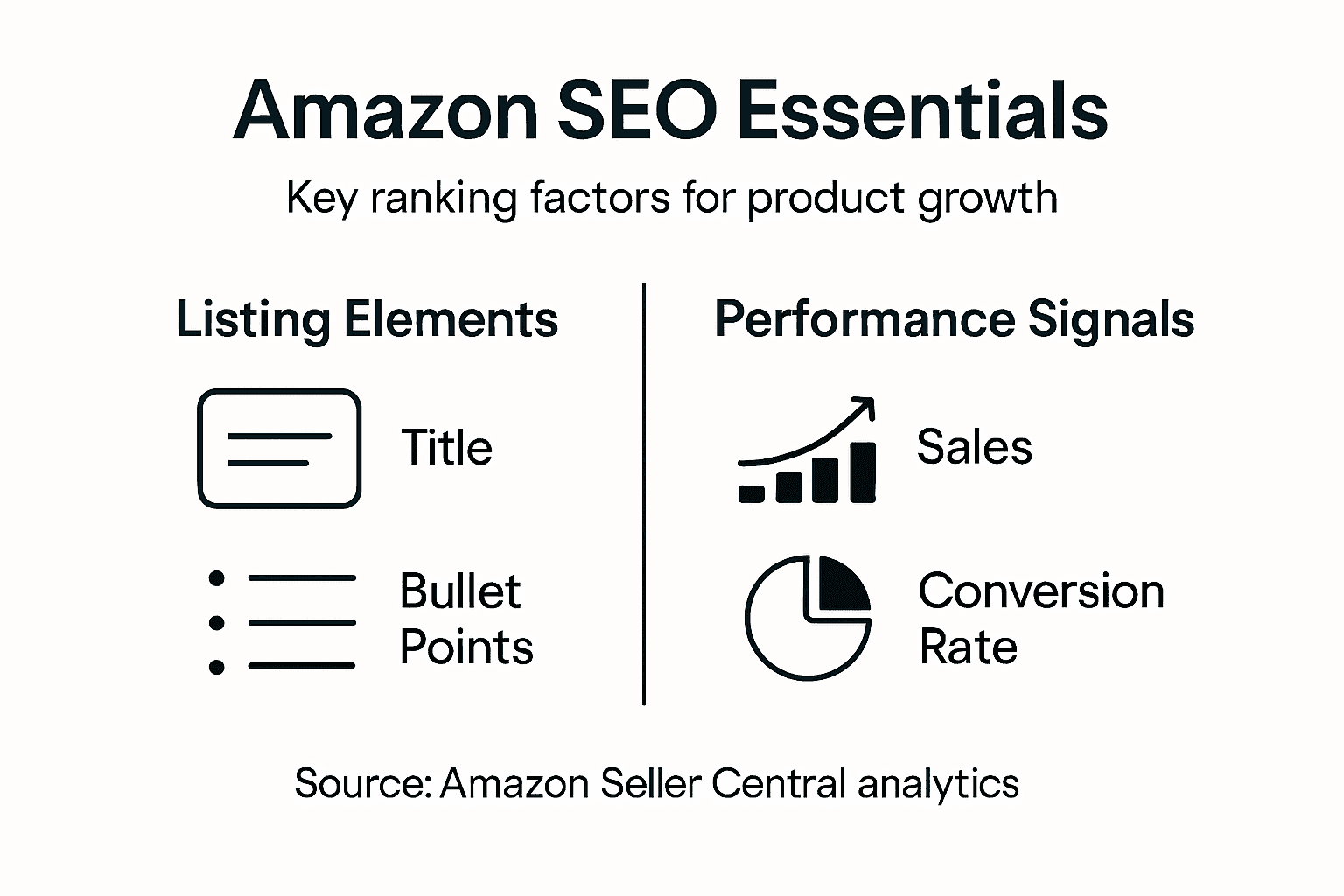
The platform continuously evaluates hundreds of signals to determine which products belong at the top of search results. Amazon’s A10 and A11 algorithms represent the evolution of these ranking systems, incorporating increasingly sophisticated data analysis. Learn about our analytics & reporting to balance relevancy with performance.
The Core Ranking Factors
Amazon weighs multiple dimensions when ranking your product. These aren’t equal-some matter far more than others.
Relevancy factors determine if your product matches the search query:
- Keyword matches in title, bullets, and backend keywords
- Product category accuracy
- Customer intent alignment
- Search query understanding through advanced technology
Performance factors measure how well your listing converts:
- Sales velocity and historical sales volume
- Click-through rate from search results
- Conversion rate once customers land on your listing
- Customer review ratings and review count
- Return rate and negative feedback
Logistical factors affect purchase likelihood:
Below summarizes the most critical ranking factors and their practical impact:
| Factor Type | Example Element | Impact on Ranking |
|---|---|---|
| Relevancy | Title keyword use | Determines if product appears |
| Performance | Conversion rate | Directly boosts ranking position |
| Logistics | Inventory levels | Affects product visibility |
- Price competitiveness against similar products
- Delivery speed and fulfillment method (FBA vs. FBM)
- Inventory availability and stock levels
- Seller performance metrics and account health
How the Algorithm Personalizes Results
Dynamic evaluation of customer behavior data means the algorithm adapts results based on who’s searching. Amazon uses product graphs and relationship mapping to understand connections between items, showing results tailored to individual shopping patterns.
Two customers searching for “wireless headphones” might see different top results based on their purchase history, price sensitivity, and past browsing behavior. The algorithm learns what each customer segment values and optimizes for those preferences.
The algorithm prioritizes products most likely to convert-not the products with the most keywords or the best reviews in isolation.
Why This Matters for Your Strategy
Understanding this mechanism changes how you optimize. You’re not gaming the algorithm; you’re making your product easier for the algorithm to sell.
If your listing has perfect keywords but low conversion rate, the algorithm won’t rank it. If your product converts customers but your title lacks keywords, the algorithm won’t show it. Success requires balance across all three dimensions: relevancy, performance, and logistics.
Pro tip: Test your pricing and monitor conversion rate weekly-small price adjustments often yield bigger ranking improvements than keyword tweaking because the algorithm prioritizes sale probability above all else.
Optimizing Product Listings for Visibility
Your product listing is your storefront on Amazon. Every element-from the title to the backend keywords-sends signals to both the algorithm and customers. When these elements work together strategically, visibility compounds exponentially.

Optimization isn’t about adding more content. It’s about placing the right content in the right places where the algorithm looks first and customers convert fastest.
The Anatomy of a High-Performing Listing
Each section of your listing serves a distinct purpose. Critical elements including tailored product titles, bullet points, and backend keywords form the foundation of Amazon visibility.
Here’s the hierarchy of importance:
- Product title: Your highest-weighted ranking factor
- Bullet points: Secondary keyword placement and feature communication
- Product description: Extended keyword real estate and story-telling
- Backend keywords: Hidden but heavily weighted by the algorithm
- Images and videos: Visual proof of product quality
- Customer reviews: Social proof and ongoing keyword signals
Your title carries approximately 40 percent of ranking weight. Bullet points carry roughly 25 percent. Every other element combined makes up the remainder. Prioritize accordingly.
Amazon PPC management including Keyword Research and Placement Strategy
Keyword research isn’t guesswork-it’s market investigation. You need to find terms customers actually search for, not terms you think they should search for.
Start by identifying your main keyword. This should appear in your title, first bullet point, and backend keywords. Secondary keywords belong in remaining bullets and the description. Long-tail keywords (three-to-five word phrases) often convert better than single-word terms because they indicate higher purchase intent.
Conducting thorough keyword research and managing customer reviews directly impacts your ability to attract qualified buyers.
Keyword density matters less than keyword placement-put your most important terms where the algorithm looks first.
Visual Optimization and Content Enhancement
Images and videos are where skeptical buyers become convinced buyers. High-resolution lifestyle photos outperform bland white backgrounds because they show real-world context.
Your primary image converts best when it fills 85 percent of the frame. Secondary images should showcase different angles, size comparisons, and the product in use. Videos demonstrating your product in action typically increase conversion rates by 15 to 30 percent compared to listings without video.
Enhanced content modules (A+ content for brand-registered sellers) give you additional real estate to tell your brand story, further differentiating from competitors.
Pro tip: Refresh your listing quarterly-add new images, update bullet points with seasonal keywords, and refresh the description to trigger the algorithm’s preference for recently-modified, actively-managed listings.
Balancing PPC, Organic Traffic, and Cost
Most Amazon sellers see PPC and organic SEO as competing strategies. In reality, they’re complementary forces that work best when orchestrated together. The question isn’t whether to choose one or the other-it’s how to allocate your budget across both to maximize profitability.
Your organic rankings determine your long-term profit potential. Your PPC campaigns determine your immediate revenue and market position. Neither survives alone in a competitive category.
The Strategic Role of Each Channel
PPC provides immediate visibility with predictable costs and high control, making it ideal for new product launches or defending market share against competitors. You pay only when someone clicks-zero organic work required.
Organic traffic, by contrast, builds slowly but scales infinitely. Once your listing ranks on page one for a high-volume keyword, traffic costs nothing. A single page-one ranking can generate hundreds of sales monthly without additional investment.
The math favors organic long-term. A product generating 50 organic sales per month at 30 percent ACOS (from organic clicks) beats a product generating 50 PPC sales at 40 percent ACOS.
Finding Your Optimal Budget Mix
Your budget allocation depends on three factors: product maturity, competitive intensity, and cash flow needs.
New products need aggressive PPC because organic rankings take 60 to 120 days to develop. Allocate 70 to 80 percent toward PPC initially. As organic rankings improve, gradually shift budget toward maintaining those rankings through continued SEO optimization.
Established products with strong organic rankings can operate on 20 to 30 percent PPC budget, using paid campaigns strategically:
- Defending against competitor ads targeting your brand keywords
- Testing new search terms before adding them to organic listings
- Launching seasonal promotions when organic demand peaks
- Capturing high-intent traffic that converts faster than organic
Using organic data to inform paid campaigns amplifies results, creating a feedback loop where each channel improves the other.
When PPC Becomes Wasteful
Some sellers burn cash on PPC that should go to organic optimization. If your listing lacks proper keyword research, inconsistent pricing, or low review count, PPC won’t fix it. The algorithm won’t rank a poorly-optimized listing regardless of advertising spend.
Before scaling PPC, audit your listing fundamentals. Invest in organic foundation work first-keyword optimization, image enhancement, review generation. Then layer PPC on top.
Organic growth compounds; PPC growth stops when spending stops. Build the foundation that generates profit at scale.
Pro tip: Track your organic search term reports monthly-these show which keywords drive actual sales at minimal cost, revealing exactly where to double down with organic optimization and reduce PPC spending.
Common Mistakes and Misconceptions
Most Amazon sellers fail not because they don’t try, but because they try the wrong things. Understanding what doesn’t work saves months of wasted effort and thousands in lost revenue. The mistakes below aren’t theoretical-they’re patterns that repeatedly tank listings.
Avoiding these pitfalls puts you ahead of 80 percent of competitors who repeat them year after year.
The Keyword Research Trap
The biggest mistake sellers make is skipping keyword research entirely. They list products using generic terms they assume customers search for, then wonder why visibility tanks.
Lack of keyword research directly impacts ranking and visibility, leaving sales on the table. Competitors using data-driven keywords outrank you immediately.
Another mistake: stuffing keywords everywhere. Some sellers jam 15 keywords into their title, creating nonsensical titles like “Wireless Blue Headphones Bluetooth Audio Premium Sound Quality Best.” Amazon penalizes this. Write for humans first, keywords second.
Poor Title and Backend Optimization
Your title is prime real estate. Many sellers waste it on branding instead of keyword placement. A title like “Brand XYZ Premium Headphones” ranks worse than “Wireless Bluetooth Headphones with Noise Cancellation for Work.”
Backend keywords are equally mishandled. Sellers either skip them entirely or repeat title keywords unnecessarily. Backend keywords should capture search variations your title can’t accommodate due to length constraints.
Here’s what actually kills rankings:
- Titles exceeding 200 characters (Amazon truncates them)
- Duplicate keywords across title, bullets, and description
- Zero backend keywords or keywords unrelated to your product
- Misspelled keywords hoping to catch typo searches
Visual and Content Mistakes
Low-quality images send immediate signals to customers and the algorithm. White backgrounds alone don’t sell-lifestyle photos showing your product in use convert better.
Weak product descriptions tell customers nothing. Your description should answer: What problem does this solve? How is it different? Who should buy it? Instead, many sellers copy competitor descriptions word-for-word, missing uniqueness that drives conversions.
Listings fail because of fundamentals, not complex strategy-fix what’s broken before optimizing what’s already working.
The Return Rate Silent Killer
High return rates destroy organic rankings faster than most sellers realize. Amazon’s algorithm treats returns as a quality signal-products with 5 percent-plus return rates rank lower than competing products with 2 percent returns, regardless of reviews or keywords.
Sellers often ignore this by focusing on getting sales without considering whether those sales stick. A customer who returns your product within 30 days actively harms your ranking.
Pro tip: Audit your return rate monthly through Seller Central reports; if it exceeds 3 percent, investigate product quality issues or listing misalignment before spending more on advertising.
Unlock Your Amazon Growth Potential with Expert SEO and Account Management
Amazon sellers face a tough challenge in driving organic growth amid fierce competition and complex search algorithms. This article highlights crucial obstacles like keyword optimization, sales velocity, and converting traffic that brands must overcome to increase visibility while reducing advertising costs. If you are struggling with balancing PPC campaigns and sustainable SEO strategies or want to protect your brand from hijackers and poor listing performance, the right support can transform your Amazon success.
Take control of your Amazon journey with Agile Consultancy specialized in full-service Amazon Seller Central account management including data-driven PPC optimization and continuous listing monitoring. Leverage proven growth strategies designed to boost your organic rankings, maximize visibility through refined keyword research, and enhance conversion rates for lasting results. Don’t let costly advertising drain your profit margins. Visit our landing page now to start your free audit and secure your brand’s position in the marketplace with experts who understand how Amazon’s SEO rules truly work.
Frequently Asked Questions
What is Amazon SEO and why is it important?
Amazon SEO refers to the practice of optimizing product listings to rank higher in Amazon’s search results. It is crucial because higher rankings increase visibility, which can lead to increased sales and organic traffic without the ongoing costs associated with paid advertising.
How does Amazon’s search algorithm determine product rankings?
Amazon’s search algorithm evaluates several factors, including keyword relevance in titles and bullet points, product reviews, sales velocity, and inventory levels. Listings that convert effectively are prioritized in search results.
What are the key elements to optimize for better Amazon SEO?
To improve Amazon SEO, focus on optimizing the product title, bullet points, backend keywords, and high-quality images. Ensuring that your listing contains relevant keywords while addressing customer needs is essential for visibility and conversions.
How can poor product listings impact my sales on Amazon?
Poorly optimized listings can lead to decreased visibility, lower conversion rates, and higher return rates. This negatively affects overall sales and can harm your product’s ranking, making it harder for potential customers to find your product.
Amazon Growth Agency - Listed in the Amazon Service Provider Network
Agency specialized in growing brands on Amazon through data-driven PPC strategies, conversion-optimized listings, and complete Seller Central account management.