Amazon VAT Compliance for EU Sellers: Complete Step-by-Step Guide
Author: Adi Malai | Category: account_health | Reading time: 14 min
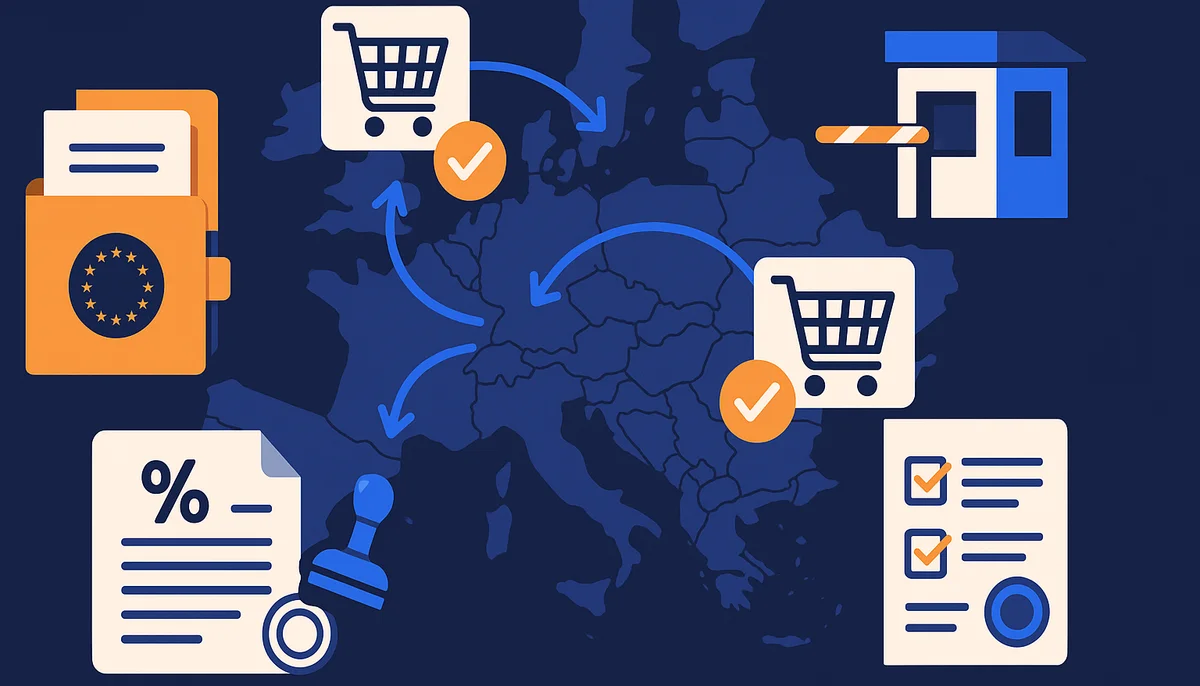
TL;DR
- Since 1 July 2021 a single EU-wide threshold of €10,000 (the combined total of your cross-border B2C sales to all other EU countries) decides when you must charge the customer's local VAT instead of your home-country rate
- The One-Stop Shop (OSS) lets you declare VAT on all your intra-EU B2C distance sales through a single return in one member state, instead of registering in each destination country
- Storing stock in another member state (for example Pan-EU FBA) can trigger a local VAT registration obligation regardless of the €10,000 threshold, because OSS does not cover stock held abroad
- Non-compliance can lead to financial penalties, interest charges and additional assessments that vary by jurisdiction, plus possible Amazon account-health and inventory restrictions
- Amazon's VAT Calculation Service calculates VAT and generates tax documents, but the seller collects and remits the VAT and remains responsible for registration and filing
- Proper documentation including EORI numbers, valid VAT certificates, and compliant invoicing is essential for maintaining account health
Selling on Amazon across multiple European marketplaces creates VAT obligations that often extend beyond a seller's home country. Knowing when to register for VAT, when OSS applies, and how Amazon's fulfilment programmes affect your tax obligations is essential for maintaining Amazon Europe VAT compliance and avoiding costly penalties.
Amazon VAT compliance for EU sellers is the systematic process of meeting tax obligations across European Union member states when selling through Amazon's European marketplaces. The complexity stems from varying national VAT rules, cross-border thresholds, and Amazon's specific compliance requirements that can impact account health and inventory accessibility.
Figures and benchmarks in this article reflect Agile Consultancy's internal experience and are not guarantees. VAT rules differ by country and change over time, so confirm your specific obligations with a qualified EU VAT advisor.
What is Amazon VAT Compliance for EU Sellers?
Amazon VAT compliance for EU sellers is a comprehensive tax framework that requires sellers to register, collect, and remit Value Added Tax (VAT) across multiple European Union jurisdictions where they exceed specific sales thresholds. This compliance system encompasses registration requirements, ongoing filing obligations, proper invoicing procedures, and adherence to Amazon's marketplace-specific VAT policies that directly impact seller account health and operational capabilities.
Destination-country VAT obligations begin once your combined cross-border B2C sales to other EU countries exceed €10,000 in a calendar year, a single EU-wide threshold since 1 July 2021. Storing stock in another EU member state (for example through Pan-European FBA) generally creates a local VAT registration obligation, regardless of the €10,000 threshold.
How Do You Achieve Amazon VAT Compliance for EU Sellers?
EU VAT compliance requires establishing proper VAT registrations in relevant jurisdictions, implementing compliant invoicing systems, and maintaining ongoing filing obligations while adhering to Amazon's specific marketplace requirements. The most important factors are: accurate threshold monitoring, timely registration before exceeding limits, proper documentation maintenance, compliant invoice generation, and regular communication with qualified EU tax advisors.
Success depends on understanding both Amazon's technical requirements and each member state's specific VAT regulations.
Key Criteria for Amazon VAT Compliance for EU Sellers
- Threshold Monitoring: Track your combined cross-border B2C sales against the €10,000 EU-wide threshold, and track where stock is stored, to know when destination-country VAT and local registration apply
- Registration Timing: Consider starting the VAT registration process 60-90 days before anticipated threshold breaches, as registration timelines vary by country and business structure
- Documentation Standards: Maintain valid VAT certificates, EORI numbers, and compliant invoice templates that meet both Amazon and local tax authority requirements
- Filing Consistency: Submit accurate VAT returns within statutory deadlines, typically monthly or quarterly depending on turnover and jurisdiction
- Account Integration: Properly configure Amazon Seller Central VAT settings and enable VAT Calculation Service where beneficial for automated compliance
- Professional Support: Engage qualified EU VAT advisors familiar with cross-border e-commerce regulations and Amazon-specific requirements
- Inventory Planning: Coordinate VAT registration timing with inventory shipments to avoid potential account restrictions or blocked stock
Understanding EU VAT Distance Selling Thresholds
How the EU-Wide Threshold Works
Until 1 July 2021, each EU country set its own distance-selling threshold (typically €35,000, or €100,000 in Germany, the Netherlands and Luxembourg). Those per-country thresholds were abolished and replaced by a single EU-wide threshold of €10,000. This €10,000 limit applies to the combined net value of all your cross-border B2C sales of goods (and certain digital services) to all other EU member states in a calendar year, not to each country individually. Below it, you may charge your home-country VAT; once you exceed it, you must charge the VAT rate of each customer's country.
Why Threshold Monitoring Matters
Crossing the €10,000 threshold without charging destination-country VAT, or selling from stock held abroad without a local registration, creates a compliance gap that can surface in Amazon account-health checks and in tax-authority audits. Based on our internal experience managing EU seller accounts, unresolved VAT issues can lead to account-health notifications and, in some cases, restrictions on the affected operations.
Consequences of Non-Compliance
Selling without the required VAT registration can lead to penalties, interest and back-VAT assessments from the relevant tax authority (amounts and rules vary by country), and can affect your Amazon account health. We have seen cases where sellers faced substantial back-VAT assessments after operating without the required registration.
How to Manage Thresholds and Registrations
- Track your combined cross-border B2C EU sales against the single €10,000 threshold using Amazon's Business and VAT Transaction Reports
- Set an internal alert well before €10,000 so you can register for OSS or destination VAT in time
- Map every country where Amazon stores your stock, since each one needs its own local VAT registration
- Coordinate with a qualified VAT advisor on timing as you grow or join Pan-EU FBA
One-Stop Shop (OSS) System Implementation
What is the OSS System
The One-Stop Shop (Union OSS) lets EU sellers declare and pay the VAT due on all their intra-EU cross-border B2C sales through a single quarterly return filed in one member state of identification, instead of registering for VAT in every destination country. OSS is not capped at €10,000: the €10,000 figure is a separate concept, the threshold above which you must start charging destination-country VAT. Once you pass it, OSS lets you keep reporting through a single return instead of many. OSS does not cover sales made from stock you hold in another country, so Pan-EU FBA and similar setups still require local VAT registrations.
Why OSS Adoption Benefits Sellers
OSS reduces the administrative burden by consolidating many destination-country filings into a single quarterly return while keeping you compliant across EU markets. It is particularly valuable once your cross-border B2C sales pass €10,000, as it avoids separate registrations in each country you sell to (though not in countries where you store stock).
Impact on Amazon Operations
OSS-registered sellers can sell across EU Amazon marketplaces while reporting cross-border B2C sales through one return, though the correct destination VAT rates must still be applied at checkout. Amazon's VAT Calculation Service can help apply those rates and produce invoices, but it is a separate tool from OSS: VCS calculates and documents VAT, while OSS is how you report and pay it.
How to Implement OSS Registration
- Register for OSS in your EU member state of identification through its tax authority
- Configure Amazon Seller Central with your VAT registration details and applicable VAT settings
- Enable VAT Calculation Service to apply correct rates and generate invoices (collection and payment remain your responsibility)
- Maintain detailed records for quarterly OSS return preparation
- Register locally for VAT in every country where your stock is stored, since OSS does not replace this
Pan-European FBA and VAT Registration
Pan-European FBA is not the same as OSS, and one does not replace the other. OSS lets you report cross-border B2C sales through a single return, but it does not cover the VAT obligations created by holding stock in another country. Under Pan-European FBA, Amazon distributes your inventory across multiple fulfilment centres, so your goods may be stored in several member states.
Storing stock in a country generally creates a local VAT registration obligation there, regardless of the €10,000 threshold. In practice this means sellers on Pan-European FBA usually need separate VAT registrations in each storage country, which commonly includes countries such as Germany, Poland, Czechia, France, Italy and Spain, depending on Amazon's current Pan-European FBA storage network, alongside their OSS registration for cross-border B2C sales. Germany is frequently one of the first countries where Amazon sellers require a local VAT registration, because Amazon stores inventory there for many sellers. However, your obligations depend on the specific countries where Amazon actually stores your inventory. The exact countries depend on where Amazon actually stores your inventory, so confirm your current storage footprint and obligations with a qualified VAT advisor before enrolling.
Amazon VAT Registration Process
Registering for VAT in an EU country usually follows a similar pattern, even though the exact steps and forms differ by member state. In most cases you will need your certificate of incorporation, evidence of business activity (such as your Amazon account or sales data), an EORI number for customs, company bank details, and identification documents for the directors. Some countries also require a local fiscal representative for non-EU businesses.
Once submitted, the tax authority reviews the application and issues a local VAT number, which you then add to Amazon Seller Central. Processing times vary by country, so prepare your documentation early and, where possible, work with a VAT advisor who handles registrations in the relevant jurisdictions.
Amazon VAT Registration Requirements by Country
VAT registration rules, rates, filing frequencies and deadlines are set at national level and differ from one member state to another. Germany, France, Italy, Spain, Poland and other countries each have their own registration process, documentation requirements and local-language filings, and some require a fiscal representative for non-EU businesses.
Because of this, there is no single "EU registration" that covers everything: your obligations depend on where you sell, where you store stock, and your turnover in each market. Before expanding into a new marketplace or enabling stock storage there, check that country's specific VAT registration requirements, ideally with a local tax advisor or a VAT compliance provider operating in that jurisdiction.
Amazon VAT Calculation Service Configuration
What is VAT Calculation Service
Amazon's VAT Calculation Service automatically calculates and displays appropriate VAT amounts to customers at checkout based on seller configuration and product categorization. This service handles rate determination, invoice generation, and basic compliance documentation while sellers remain responsible for registration and filing obligations.
Why Service Configuration Matters
Proper VAT Calculation Service setup ensures accurate tax collection and reduces compliance risks while providing customers with transparent pricing. Incorrect configuration can lead to over-collection or under-collection of VAT, creating reconciliation problems during filing periods and potential customer disputes.
Impact of Misconfiguration
Sellers with incorrectly configured VAT settings face significant reconciliation challenges during filing periods, potential overpayments to tax authorities, and customer complaints about unexpected tax charges. In our experience, VAT misconfigurations can result in substantial reconciliation costs and overpayments.
How to Optimize Service Configuration
- Verify product categorization for accurate VAT rate application
- Test checkout calculations across different customer locations
- Review VAT Transaction Reports monthly for accuracy validation
- Coordinate rate changes with tax advisors before implementation
- Enable service gradually by marketplace to identify configuration issues early
Cross-Border Inventory and Fulfillment Compliance
What Constitutes Compliant Cross-Border Operations
Cross-border compliance requires proper VAT treatment of inventory movements between EU countries, appropriate documentation for customs procedures, and adherence to both origin and destination country regulations. This includes understanding when inventory transfers trigger VAT obligations and how Amazon's fulfilment network affects tax liabilities. Holding stock in a country (for example through Pan-European FBA) generally creates a local VAT registration obligation there, regardless of the €10,000 threshold, and OSS does not replace it.
Why Inventory Compliance Affects Account Health
Amazon may request VAT-related documentation and can restrict certain inventory movements or participation in specific fulfilment programmes when compliance issues arise. Proper compliance ensures uninterrupted inventory flow across European fulfilment centres and maintains operational flexibility during peak seasons.
Impact of Non-Compliance on Operations
Sellers without the required VAT registration may face delays in inventory processing, restrictions on certain fulfilment programmes, or requests for additional compliance documentation. These operational restrictions directly impact sales velocity and competitive positioning.
How to Ensure Inventory Compliance
- Complete VAT registration before initiating cross-border inventory transfers
- Obtain EORI numbers for customs documentation requirements
- Coordinate with Amazon's FBA team on compliance status verification
- Maintain proper invoicing for inventory movements between countries
- Plan inventory distribution based on VAT registration status across markets
Documentation and Record-Keeping Requirements
What Documentation EU Compliance Requires
EU VAT compliance demands comprehensive record-keeping including sales invoices, purchase receipts, VAT registration certificates, customs documentation, and detailed transaction logs. Amazon requires specific document formats and maintains audit capabilities that sellers must support with proper documentation systems.
Why Proper Documentation Protects Sellers
Adequate documentation provides legal protection during tax authority audits, supports Amazon account appeals processes, and enables accurate VAT return preparation. Tax authorities increasingly focus on e-commerce sellers, making proper documentation essential for avoiding penalties and maintaining compliance.
Impact of Inadequate Record-Keeping
Sellers with insufficient documentation face extended audit processes, estimated tax assessments that often exceed actual liabilities, and potential Amazon account restrictions during investigation periods.
How to Establish Compliant Documentation Systems
- Implement automated invoice generation systems that meet EU formatting requirements
- Maintain separate filing systems for each VAT registration jurisdiction
- Archive transaction records for minimum seven-year retention periods
- Use cloud-based systems for secure document storage and retrieval
- Establish monthly reconciliation procedures between Amazon reports and internal records
Amazon VAT Compliance Comparison
The cost ranges below are indicative estimates based on our experience and may vary significantly depending on provider, country, filing volume, and business complexity.
| Compliance Method | Registration Complexity | Filing Requirements | Cost Range | Best for |
|---|---|---|---|---|
| OSS Registration | Low - Single country | Quarterly returns | €500-1,500/year | Cross-border B2C sellers without stock held abroad |
| Country-Specific VAT | High - Multiple jurisdictions | Monthly/Quarterly per country | €2,000-5,000/year | Sellers storing stock in multiple countries (e.g. Pan-EU FBA) |
| VAT Representative | Medium - Delegated process | Managed by representative | €3,000-8,000/year | Non-EU sellers or complex operations |
| Hybrid Approach | Variable - Depends on mix | Mixed filing schedule | €1,500-4,000/year | Sellers transitioning between methods |
How to Achieve Amazon VAT Compliance for EU Sellers Step by Step
Assess Your Threshold and Stock Footprint: Calculate your combined cross-border B2C EU sales against the €10,000 threshold using Amazon Business Reports, and list every country where Amazon stores your stock, since each storage country needs its own VAT registration.
Determine Optimal Registration Strategy: Decide whether OSS (one return for your cross-border B2C sales) is enough, or whether you also need local registrations because you store stock abroad or want full Pan-EU FBA coverage.
Complete VAT Registration Process: Submit applications through local tax authorities or qualified representatives, ensuring all required documentation including business registration, financial statements, and operational details are properly prepared and submitted.
Configure Amazon Seller Central Settings: Update VAT registration details across all relevant marketplaces, enable VAT Calculation Service where beneficial, and verify that product categorization aligns with applicable VAT rates for accurate collection.
Implement Compliant Invoicing Systems: Establish automated invoice generation that meets EU formatting requirements, includes all mandatory information, and integrates with Amazon's transaction data for seamless record-keeping and reconciliation.
Establish Filing and Payment Procedures: Set up regular filing schedules with qualified tax advisors, implement monthly reconciliation processes between Amazon reports and VAT obligations, and establish payment procedures that meet statutory deadlines.
Monitor Ongoing Compliance Status: Create monthly review processes for threshold monitoring, maintain current VAT certificates in Amazon systems, and establish communication protocols with tax advisors for regulatory updates and compliance changes.
Plan for Scale and Growth: Develop procedures for expanding to additional EU markets, establish processes for handling increased complexity as sales grow, and maintain flexibility to adapt compliance strategies based on business development and regulatory changes.
Common Patterns
Based on our experience supporting Amazon sellers operating across multiple EU marketplaces, the most successful companies set up OSS or local registrations before reaching the €10,000 threshold, rather than waiting until a compliance gap occurs. Sellers who proactively register typically maintain smoother operations and avoid the account disruptions and compliance delays we commonly observe among reactive compliance approaches.
The highest-risk period occurs during Q4 when sales spikes can push sellers over the €10,000 threshold unexpectedly, making October a good month for threshold assessments and preemptive registrations. Sellers operating in electronics, home goods, and seasonal categories show the highest threshold breach rates during peak periods.
Frequently Asked Questions
What is the sales threshold for Amazon VAT compliance in the EU?
Since 1 July 2021 there is a single EU-wide threshold of €10,000 per calendar year. It applies to the combined total of your cross-border B2C sales to all other EU countries, not to each country separately. Below €10,000 you can charge your home-country VAT; once you exceed it you must charge each customer's local VAT rate and either register in each destination country or use the OSS. Separately, storing stock in a country generally requires a local VAT registration there, independent of the €10,000 threshold.
Why is VAT compliance important for Amazon EU sellers?
VAT compliance affects your Amazon account health, your ability to operate smoothly across EU markets, and your legal standing. Non-compliance can lead to penalties, interest and back-VAT assessments that vary by country, and can trigger Amazon account-health or operational restrictions. Amazon may request evidence of VAT compliance and can impose restrictions where compliance issues are identified.
How do you register for VAT in multiple EU countries efficiently?
Once your cross-border B2C sales pass the €10,000 EU-wide threshold, OSS registration in your member state of identification lets you cover all those sales with one return instead of registering in each destination country. Storing stock in another member state generally requires a local VAT registration there (for example under Pan-EU FBA). Professional representation typically costs €2,000-3,000 per country annually in our experience, but ensures compliant registration and ongoing filings.
When should Amazon sellers start the VAT registration process?
Begin VAT registration 60-90 days before anticipated threshold breaches to ensure compliance continuity. For seasonal sellers, start the process in August-September before Q4 sales spikes. Registration timelines vary by country from 2-8 weeks, with Germany and France typically requiring 4-6 weeks while smaller markets may complete registration within 2-3 weeks.
Does Amazon automatically pay VAT on my behalf?
No. Amazon can calculate VAT through its VAT Calculation Service, but sellers remain responsible for VAT registration, filing, and payment obligations.
Conclusion
VAT compliance across Amazon Europe marketplaces represents a critical operational requirement that directly impacts account health, inventory accessibility, and long-term marketplace viability. The complexity of managing multiple jurisdictions, varying thresholds, and Amazon-specific requirements demands systematic approaches that combine proper registration timing, compliant documentation systems, and ongoing professional support. Successful compliance requires proactive threshold monitoring, strategic registration decisions, and integration with Amazon's technical requirements to maintain operational continuity across European markets.
The investment in proper VAT compliance infrastructure typically pays for itself through avoided penalties, uninterrupted operations, and maintained competitive positioning across EU marketplaces. Sellers who establish robust compliance frameworks before reaching threshold limits consistently outperform reactive approaches in both operational stability and growth trajectory. The key lies in treating VAT compliance as a strategic enabler rather than a regulatory burden, allowing sellers to scale confidently across European markets while maintaining full legal and operational compliance.
If you need professional implementation of EU VAT compliance strategies, see our Amazon brand protection services or book a free consultation.
Co-Founder & Compliance Lead - Amazon SPN Approved Partner
Adi oversees complete Amazon account management for growing brands - from health checks and listing optimization to inventory strategy and expansion across European marketplaces.