Amazon Sales Plateau 2026: Why Brands Stall & Break Through
Author: Adinel Arcalianu | | Category: Strategy | Reading time: 12 min
TL;DR
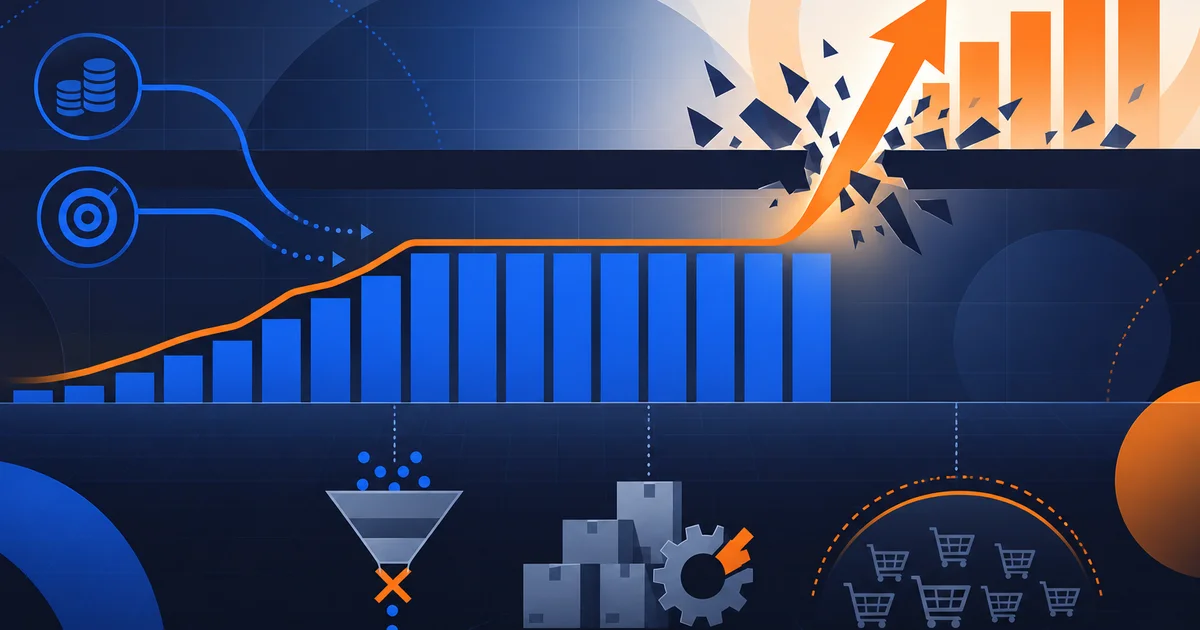
- An Amazon sales plateau is a period of flat revenue despite stable or rising inputs like ad spend, inventory, and catalog size, and it usually has a diagnosable root cause.
- A common cause of a plateau in mature accounts is saturating the existing keyword set: the brand has captured most of the demand it targets, so more spend buys only marginal clicks.
- Flat sales combined with rising TACoS means advertising efficiency is deteriorating; it may indicate that ads are replacing organic sales, but it can also reflect higher CPCs, weaker ad conversion, or declining organic demand.
- Conversion decay from new competitors, price pressure, or weaker reviews can stall growth even when traffic stays constant.
- Inventory gaps, stockouts, and storage limits quietly cap sales and damage organic rank for weeks after restock.
- The best approach to breaking a plateau is to diagnose before you spend: separate demand, traffic, conversion, and operational problems, then fix the constraint that binds first.
An Amazon sales plateau happens when a brand's revenue stops growing even though the seller keeps investing in ads, listings, and inventory. In our experience managing 100+ brands, a sales plateau rarely happens at random. It is usually a demand ceiling, a conversion problem, or an operational constraint that the current strategy can't push through.
What is an Amazon Sales Plateau?
An Amazon sales plateau is a sustained period, typically several months, in which a brand's revenue stays flat or declines slightly while its inputs (ad spend, catalog, inventory, effort) remain stable or increase. It differs from a seasonal dip because it persists after adjusting for seasonality and year-over-year category trends.
It matters because a plateau usually signals that the growth model itself has hit its limit, and spending more inside the same model tends to erode margin without moving revenue.
How do you break an Amazon sales plateau?
You break an Amazon sales plateau by identifying the main constraint on growth: demand, traffic share, conversion, or operations. Then you fix that constraint specifically instead of raising budgets across the board. Most brands that answer "why are my Amazon sales flat" with "spend more on PPC" make the plateau more expensive, not shorter.
The most important factors are: total addressable search demand, share of that demand you capture, listing conversion rate, organic rank stability, inventory continuity, and catalog breadth.
Key Criteria for Diagnosing an Amazon Sales Plateau
- Demand trend: Check whether search volume for your core terms is growing, flat, or shrinking using Brand Analytics and Product Opportunity Explorer.
- Search visibility and share: Use the Search Query Performance report to compare your brand's impression, click, add-to-cart, and purchase shares for your top queries. For paid visibility, use the relevant Amazon Ads campaign and placement reports.
- TACoS direction: Track whether TACoS is rising while revenue stays flat, which signals declining advertising efficiency and may indicate that ads are cannibalizing organic sales.
- Conversion rate trend: Compare unit session percentage over a rolling 90-day window against the prior period to detect listing or competitive decay.
- Organic rank stability: Monitor organic positions for your top 10-20 revenue-driving keywords to catch erosion before it shows in sales.
- Inventory continuity: Review stockout days, IPI score, and FBA capacity limits separately, since gaps in availability cap sales regardless of demand.
- Catalog concentration: Calculate how much revenue depends on your top one or two ASINs, because heavy concentration makes growth more vulnerable to competitive changes, stockouts, and declining demand.
Demand Ceiling: Why Amazon Growth Stalled at Category Saturation
A common cause of an Amazon sales plateau in mature accounts is that the brand has already captured most of the search demand it currently targets. A keyword-level ceiling does not mean the brand has exhausted its total addressable market; it means further growth requires new demand.
What it is
A demand ceiling occurs when your listings rank and advertise on nearly all relevant keywords, and the total volume of those keywords isn't growing fast enough to lift your sales.
Why it happens
Brands typically launch around a tight cluster of high-intent keywords. That works well until they win the top positions. After that, the remaining growth must come from adjacent queries, new products, or new marketplaces, and most brands don't plan for that transition.
Impact
When you hit a demand ceiling, extra budget buys low-relevance clicks with weak conversion. One of our clients in the kitchen accessories category increased PPC spend significantly over two quarters and saw almost no revenue change, because they already held top-of-search positions on every core term.
How to fix
- Use Brand Analytics to identify relevant search queries you don't yet target, and Product Opportunity Explorer to investigate adjacent customer needs, underserved niches, and competitor products.
- Expand the catalog with variations, bundles, or complementary products that open new keyword clusters.
- Evaluate new marketplaces where your category demand is underserved.
- Test Sponsored Brands video and Sponsored Display to reach shoppers earlier in the funnel instead of competing only on exhausted search terms.
PPC Diminishing Returns: Amazon Sales Flat but TACoS Rising
When sales stay flat but TACoS rises, advertising efficiency is deteriorating. This may mean paid campaigns are capturing sales that would have happened organically, but it can also reflect higher CPCs, weaker ad conversion, or declining organic demand, so compare paid and organic sales trends before deciding.
What it is
Diminishing returns describe the point where each additional unit of ad spend generates less incremental revenue than the one before. The key difference between ACoS and TACoS is that ACoS measures ad efficiency in isolation, while TACoS shows whether ads grow total revenue. Our breakdown of why TACoS matters more than ACoS for overall growth explains this relationship in detail.
Why it happens
Common mistakes include: bidding aggressively on branded terms you'd win organically, running broad and auto campaigns without negative keyword hygiene, and scaling budgets on campaigns that already have high impression share. Sponsored Products then captures clicks that would have converted organically anyway.
Impact
In the accounts we manage, rising TACoS paired with flat revenue is one of the clearest early warnings of a plateau. Margin compresses every month while the top line stays the same, and the seller often interprets this as "we need even more ads."
How to fix
- Run a structured audit using our Amazon PPC audit checklist of 15 checks that expose wasted ad spend.
- Run controlled bid-reduction tests on selected branded and organically dominant keywords, and compare total sales, organic sales, ad-attributed sales, and contribution margin against a comparable baseline.
- Move budget from saturated exact-match campaigns toward discovery campaigns on new, relevant search terms.
- Use Sponsored Products to promote individual products in relevant shopping placements, Sponsored Brands to increase brand visibility and support product discovery, and Sponsored Display to reach relevant audiences through the contextual and audience-targeting options available in your marketplace. Don't let one ad type do every job.
For brands without in-house capacity, our Amazon PPC management service restructures campaigns around incrementality rather than ACoS alone.
Conversion Decay: Why Amazon Sales Dropped While Traffic Held
Conversion decay is a gradual decline in the rate at which sessions turn into orders, and it often explains Amazon sales decline causes that sellers can't see in traffic data.
What it is
Conversion decay happens when your listing becomes less competitive relative to the alternatives shown next to it, even though your listing itself hasn't changed.
Why it happens
New competitors enter with lower prices, better images, more reviews, or stronger A+ Content. Coupons and deals from competitors change shopper expectations. Your review rating may slip from a cluster of negative reviews tied to a product or packaging issue. Amazon's AI shopping assistant also gives customers conversational access to product information and comparisons, which makes clear, accurate listing content increasingly important.
Impact
Lower conversion can hurt twice: you sell fewer units from the same traffic, and weaker sales performance can reduce organic visibility over time, which lowers traffic too. One of our clients in the supplements category saw their unit session percentage slide steadily over a 90-day window after two competitors launched with lower price points and video-led listings. Their sessions barely changed, but revenue fell noticeably.
How to fix
- Benchmark your main image, price, rating, and review count against the top five competitors on your primary keyword.
- Refresh images and A+ Content around the objections that appear in negative reviews.
- Analyze review text for recurring product complaints and fix the product, not just the listing.
- Test price and coupon positioning against your margin floor rather than matching competitors blindly.
- Use Manage Your Experiments, available for eligible ASINs of brands enrolled in Brand Registry, to A/B test titles, images, and A+ Content. Brand Registry requires a registered trademark or, in eligible cases, a pending trademark application.
Organic Rank Erosion: The Silent Driver of Flat Sales
Organic rank erosion is the gradual loss of unpaid search positions, and it is one of the most underestimated reasons brands ask why their Amazon sales are flat.
What it is
Rank erosion means your listing slides from page-one positions to lower placements on keywords that once drove meaningful organic orders.
Why it happens
Amazon's organic rankings reflect product relevance and customer shopping behavior, including purchase-related signals and offer availability, although Amazon does not disclose the precise weighting of its ranking signals. Our guide to Amazon organic ranking factors beyond keywords and reviews covers the full picture. When competitors build sales faster, or when a poorly planned content change weakens keyword relevance, your position can slip even if your own sales seem steady at first.
Impact
Losing organic positions forces you to buy back the same traffic through ads, which is exactly what drives TACoS up during a plateau. In our observations, brands that don't track organic rank weekly often discover erosion only after it has already compounded into a revenue problem.
How to fix
- Track organic positions weekly for your top 10-20 revenue keywords.
- Use the Search Query Performance report to compare your click and purchase share against total query volume.
- Support slipping keywords with targeted Sponsored Products exact-match campaigns while you fix the underlying conversion or relevance issue.
- Audit backend search terms and title relevance after any listing edit.
Operational Constraints: Inventory, Stockouts, and Storage Limits
Operational constraints cap sales from the supply side, and they can create a plateau that no marketing change will fix.
What it is
These constraints include stockouts, out-of-stock or unbuyable offers that stop ad delivery, FBA capacity limits tied to IPI performance, and slow replenishment cycles.
Why it happens
As brands grow, forecasting often fails to keep pace. Sellers order cautiously to protect cash flow, then run out during demand peaks. Capacity limits can block inbound shipments exactly when the brand needs to scale.
Impact
An out-of-stock period prevents customers from buying the affected offer, can interrupt ad delivery, and can allow competitors to gain visibility and sales. In the accounts we manage, recovering organic rank after a meaningful stockout has often taken several weeks after restock, depending on stockout duration and competition, which means the true cost is much larger than the lost days of sales. One of our clients in pet supplies experienced repeated short stockouts during peak season and spent the following quarter rebuilding positions they had held before.
How to fix
- Build a demand forecast that includes seasonality, promotions, and lead-time buffers.
- Monitor your IPI score, FBA capacity limits, and capacity utilization separately (Amazon considers IPI alongside other factors when setting capacity), and remove slow-moving inventory before it constrains your best sellers.
- Set reorder points per ASIN based on velocity, not on a fixed calendar.
- Consider multi-channel fulfillment or a backup 3PL for critical SKUs.
Our Amazon account management service connects inventory planning with advertising and listing decisions so that one function doesn't undermine the others.
Amazon Sales Plateau Comparison
| Plateau Cause | Primary Signal | Where to Check | Typical Fix | Time to Impact |
|---|---|---|---|---|
| Demand ceiling | Flat search volume, high impression share | Brand Analytics, Product Opportunity Explorer | Catalog expansion, new marketplaces | Months |
| PPC diminishing returns | TACoS rising, revenue flat | Advertising Console, Business Reports | Incrementality testing, budget reallocation | Weeks |
| Conversion decay | Falling unit session percentage | Business Reports, competitor listings | Listing refresh, pricing, product fixes | Weeks to months |
| Organic rank erosion | Lost page-one positions | Search Query Performance, rank tracker | Relevance fixes, targeted exact-match support | Weeks |
| Operational constraints | Stockout days, capacity warnings | Inventory dashboard, IPI score | Forecasting, reorder points, inventory cleanup | Months |
Timelines reflect what we typically see in the accounts we manage and vary by category. Use these signals to prioritize your investigation, not as proof of a single cause: if TACoS is rising, start with PPC and organic rank; if conversion is falling, start with competitive benchmarking; if neither explains the stall, check for a demand ceiling, then validate the suspected cause against other account and market data before changing strategy.
How to Break an Amazon Sales Plateau Step by Step
- Normalize the data: Pull 12 months of revenue, sessions, conversion, and ad spend, and adjust for seasonality so you compare like with like.
- Check demand: Use Brand Analytics and Product Opportunity Explorer to confirm whether search volume for your core terms is growing, flat, or shrinking.
- Measure share: Review the Search Query Performance report to see how much impression, click, and purchase share you already own.
- Separate paid from organic: Compare paid and organic sales trends, branded and non-branded campaign performance, and the results of controlled bid or budget changes to assess whether ads are adding sales or replacing them.
- Benchmark conversion: Compare your price, images, rating, and review count with the top competitors on your primary keywords.
- Audit operations: Review stockout history, IPI, and capacity limits for the past 12 months.
- Fix the primary constraint first: Address the primary bottleneck before spreading effort across every possible improvement.
- Expand deliberately: Once the core is stable, add adjacent products, new keyword clusters, or new marketplaces to raise the demand ceiling.
Common Patterns
Across the 100+ brands we have worked with, plateaus follow recognizable patterns:
- Single-hero dependency: In our experience, brands that rely on one ASIN for most of their revenue are more exposed to competitive changes and inventory disruptions than brands with a balanced catalog.
- Budget escalation as the default response: Most sellers respond to flat sales by raising PPC budgets, which in our experience usually raises TACoS without restoring growth.
- Plateaus follow competitive entry: In the accounts we manage, many stalls began within a few months of well-funded competitors entering the category with better creative or lower prices.
- Post-stockout stall: Brands that experienced a peak-season stockout frequently show flat performance the following quarter while rank recovers.
- Multiple causes stacking: A plateau is rarely one problem. Demand saturation usually triggers PPC overspend, which masks conversion decay until revenue finally stalls.
Frequently Asked Questions
What is an Amazon sales plateau?
An Amazon sales plateau is a sustained period of flat revenue despite stable or rising investment in ads, inventory, and listings. It persists after adjusting for seasonality and usually indicates a structural constraint in demand, conversion, or operations.
Why is diagnosing an Amazon sales plateau important?
Diagnosing a plateau matters because the wrong fix can make it more expensive without ending it. Raising ad budgets during a demand ceiling, for example, increases TACoS and compresses margin while revenue stays flat.
How do you increase Amazon sales after a plateau?
You increase Amazon sales after a plateau by fixing the binding constraint first, then expanding into new demand. That means stabilizing conversion, organic rank, and inventory before adding products, keyword clusters, or marketplaces.
Why have my Amazon sales plateaued despite more ad spend?
Your sales may have plateaued despite more ad spend because the extra budget is buying clicks that would have converted organically, clicks with low relevance, or clicks at higher CPCs. Testing bid reductions on branded and top-ranked terms usually reveals how much of your spend is truly incremental.
How long does it take to break through an Amazon sales plateau?
Breaking through a plateau typically takes anywhere from a few weeks for PPC and rank fixes to several months for catalog or marketplace expansion, based on our experience. The timeline depends on which constraint is binding and how quickly you can execute the fix.
Conclusion
An Amazon sales plateau is a symptom, not a diagnosis. The most common causes are demand saturation, PPC diminishing returns, conversion decay, organic rank erosion, and operational constraints, and they often stack on top of each other. Brands that separate these causes with data from Brand Analytics, the Search Query Performance report, and their inventory dashboards can identify the real bottleneck instead of guessing.
Our recommendation, based on our experience scaling brands across Europe and the US, is simple: diagnose before you spend. The fastest way out of a plateau is rarely more budget; it is fixing the one constraint that is holding everything else back. Once the core is stable, expand growth opportunities through a broader product range and new markets rather than squeezing more out of the same keywords.
If you need professional implementation, see our Amazon account management service or book a free audit.
Ready to Optimize Your Amazon Listings?
Request a free audit and discover how we can boost your brand's visibility and sales.
Get Your Free AuditCo-Founder & Amazon Strategist - Listed in the Amazon Service Provider Network
Adinel manages complete Amazon accounts for brands across Europe and the US - ads, strategy, listings, launches. With 10+ years of experience and 80+ brands scaled to over €30M in managed revenue.