What Is Amazon Seller Central? 30% Listing Hijack Risk
Author: Adi Malai | | Category: Blog | Reading time: 11 min

Listing hijacking accounts for up to 30% of product problems on Amazon, yet many brand owners remain unaware of the threat until sales plummet. Amazon Seller Central is the primary platform US sellers use to manage their marketplace operations, but its complexity leaves gaps in protection and optimization. This guide reveals how to master Seller Central’s features, shield your listings from unauthorized sellers, and implement strategies that drive sustainable growth while safeguarding your brand integrity.
Table of Contents
- Introduction to Amazon Seller Central
- Core Features of Amazon Seller Central for Sellers
- Understanding Listing Hijacking and Protection Mechanisms
- Common Misconceptions About Seller Central
- Comparison of Seller Central vs Vendor Central
- Optimizing Seller Central Accounts for Growth
- Conclusion and Next Steps to Effectively Manage Your Seller Central Account
- Boost Your Amazon Success with Expert Seller Central Support
- Frequently Asked Questions About Amazon Seller Central
Key Takeaways
| Point | Details |
|---|---|
| Central Management Hub | Seller Central consolidates product listings, see our account management services, inventory control, order processing, and sales analytics in one platform for third-party sellers. |
| Hijacking Threatens Revenue | Up to 30% of listing problems stem from unauthorized sellers, requiring active monitoring and Brand Registry enrollment. |
| Account Health Determines Status | Metrics like order defect rate under 1% and late shipment rate below 4% directly impact selling privileges and suspension risk. |
| Platform Choice Matters | Seller Central offers control over pricing and listings while Vendor Central positions you as a supplier with Amazon controlling retail decisions. |
| Growth Requires Integration | Combining listing optimization, PPC analytics, and continuous hijack monitoring creates sustainable sales increases with lower advertising costs. |
Introduction to Amazon Seller Central
Amazon Seller Central is the centralized management platform for third-party sellers to handle every aspect of their US marketplace operations. Millions of sellers rely on this hub to control inventory, process orders, manage payments, and access detailed performance reports. Understanding its structure and capabilities forms the foundation for protecting your brand and scaling sales effectively.
Two primary account types serve different seller needs. Individual accounts charge $0.99 per sale with no monthly fee, ideal for casual sellers moving fewer than 40 items monthly. Professional accounts cost $39.99 monthly but unlock bulk listing tools, advertising options, and API access essential for serious brand owners.
Basic setup follows a clear path. You register with business details, verify your identity through Amazon’s requirements, add products via manual entry or bulk uploads, and configure fulfillment preferences. Brand owners gain significant advantages by enrolling in Brand Registry, which unlocks protection tools and enhanced content features that individual sellers cannot access.
- Registration requires valid business information and tax identification
- Identity verification uses government-issued documents and bank account confirmation
- Product addition supports single listings or catalog imports for efficiency
- Brand Registry enrollment demands trademark ownership but provides critical protections
The Amazon Seller Central official overview details each setup requirement and documentation needed for US sellers. Completing this foundation properly prevents account issues and positions you to leverage advanced features effectively.
Core Features of Amazon Seller Central for Sellers
Seller Central’s daily tools determine how efficiently you manage operations and respond to marketplace dynamics. Product listing management sits at the core, allowing you to create optimized pages, control inventory levels, and adjust pricing strategies in real time. These capabilities directly impact visibility and conversion rates.
Order processing flexibility gives you control over fulfillment methods. Fulfillment by Amazon handles storage, packing, and shipping while you focus on sourcing and marketing. Seller-fulfilled orders keep logistics in your hands but require meeting strict delivery standards to maintain account health.
Dashboards transform raw data into actionable intelligence. Sales performance metrics show revenue trends, traffic sources, and conversion patterns. Traffic analytics reveal which keywords drive visitors and where customers drop off. Account Health metrics track compliance across multiple dimensions that determine your standing.
Critical metrics demand constant attention:
- Order defect rate must stay below 1% to avoid warnings
- Late shipment rate requires under 4% for maintained privileges
- Policy compliance covers product authenticity and listing accuracy
- Customer service response time affects buyer satisfaction scores
Pro Tip: Check your Account Health dashboard every morning before reviewing sales data. Catching policy violations or performance drops early prevents escalation to suspension threats and protects revenue continuity.
The Seller Central account health metrics explanation provides threshold details and remediation steps for each tracked element. Falling below standards triggers warnings, restrictions, or complete account suspension depending on severity and response speed.
Understanding Listing Hijacking and Protection Mechanisms
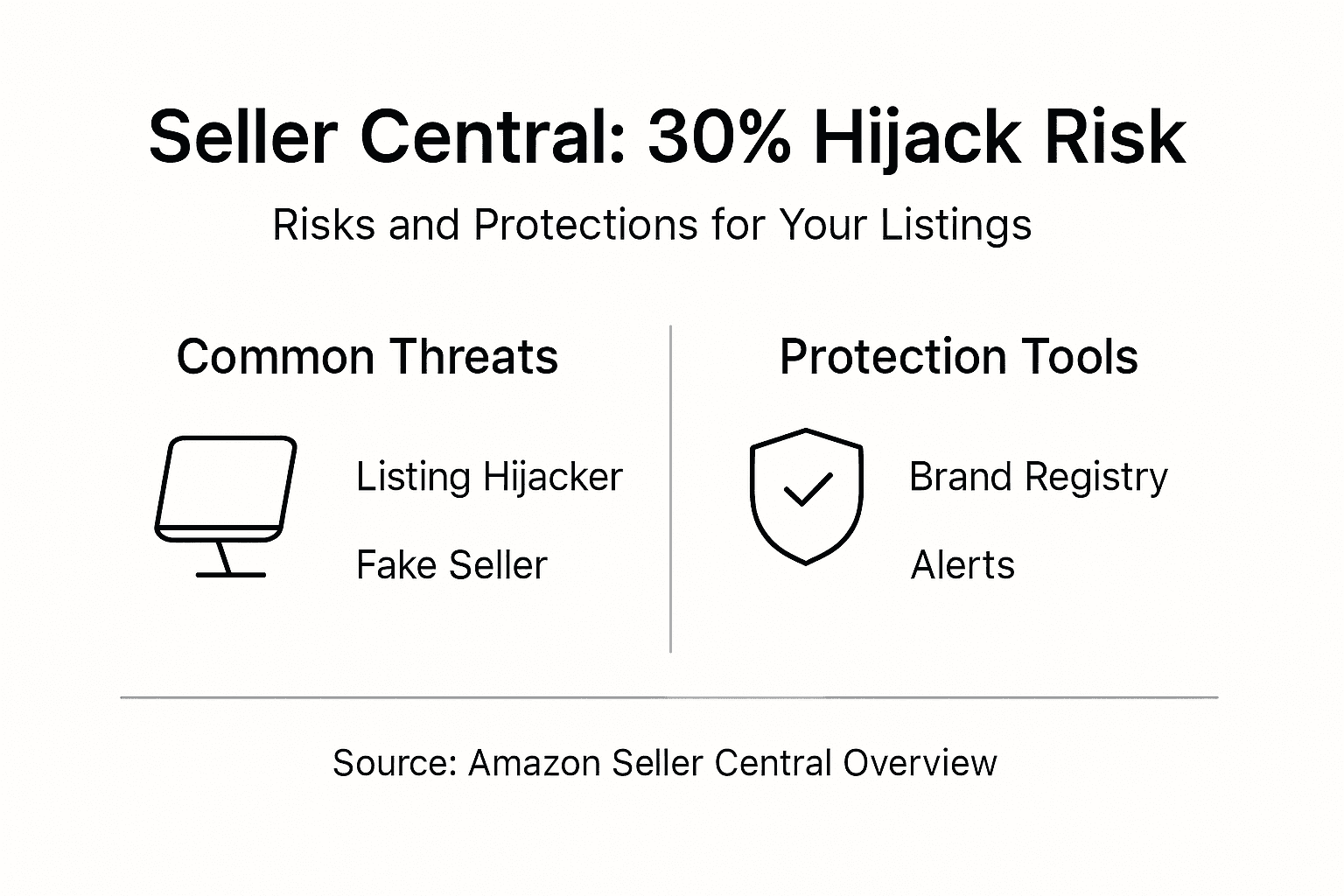
Listing hijacking represents one of the costliest threats facing brand owners on Amazon. Unauthorized sellers attach themselves to your product pages, often offering counterfeit goods or undercutting prices to steal your Buy Box. This practice causes customer confusion, dilutes brand value, and diverts sales to competitors who invested nothing in building your product reputation.

Listing hijacking accounts for up to 30% of reported product listing problems across Amazon’s marketplace. The financial impact extends beyond immediate lost sales. Negative reviews from counterfeit purchases damage your brand rating permanently, while customer service burdens increase as buyers complain about quality issues with unauthorized products.
Brand Registry enrollment provides your first line of defense. This program verifies trademark ownership and unlocks tools designed specifically for brand protection. Once enrolled, you gain access to automated monitoring systems and report mechanisms that prioritize brand owner complaints over generic seller disputes.
Up to 30% of product listing problems stem from unauthorized seller activity, making active protection essential for maintaining sales and brand integrity in competitive Amazon categories.
Amazon deploys machine learning models that analyze listing behavior patterns continuously. These systems flag suspicious seller additions, pricing anomalies, and inventory sources that don’t match established patterns. When potential hijackers appear, alerts notify brand owners through Seller Central dashboards and email notifications.
Effective protection strategies combine technology with rapid response:
- Enroll in Brand Registry immediately upon trademark approval
- Enable automated monitoring alerts for all your ASINs
- Document authentic product details including packaging and features
- Report suspicious sellers within hours of detection, not days
- Follow up on reports to ensure Amazon removes violators completely
The Amazon Brand Registry protection tools include Report a Violation workflows, automated brand protection systems, and priority support channels. Combining these resources with daily monitoring reduces hijacking incidents and minimizes revenue loss when unauthorized sellers attempt infiltration.
Common Misconceptions About Seller Central
Many sellers harbor false beliefs about how Seller Central operates, leading to inadequate protection strategies and missed growth opportunities. Addressing these misconceptions prevents costly mistakes and sets realistic expectations for platform capabilities.
The biggest myth suggests Seller Central automatically prevents listing hijacking without seller involvement. Amazon’s systems detect many threats, but they cannot catch every unauthorized seller instantly. Brand owners must actively monitor listings, report violations promptly, and maintain Brand Registry enrollment to access protection features.
Another widespread belief claims Amazon PPC management including PPC campaigns alone guarantee sales growth. While advertising drives traffic, conversion depends on optimized listings, competitive pricing, adequate inventory, and strong reviews. Sellers who pour money into ads without addressing listing quality waste budgets on visitors who bounce without buying.
Confusion between Seller Central and Vendor Central creates planning problems. These platforms serve fundamentally different business models. Seller Central empowers third-party sellers to control their own operations. Vendor Central converts you into a wholesale supplier where Amazon owns the customer relationship and controls pricing decisions.
Account Health metrics suffer from dangerous neglect. Some sellers treat performance thresholds as suggestions rather than requirements. Ignoring order defect rates or late shipment warnings leads directly to suspension. Amazon enforces these standards strictly because they protect customer experience across the entire marketplace.
- Automated protection requires your active participation and monitoring
- PPC success depends on integrated strategies beyond advertising spend
- Platform choice determines your control level and business model
- Account Health metrics directly control your ability to sell
Pro Tip: Treat Seller Central as a business partnership requiring your daily attention, not a passive sales channel. Combine automated tools with manual oversight, diversify growth tactics beyond advertising, and respond to performance issues within hours to maintain operational continuity.
Comparison of Seller Central vs Vendor Central
Choosing between Seller Central and Vendor Central shapes your entire Amazon business model. Understanding their differences helps you select the path aligned with your control preferences, growth goals, and operational capabilities.
| Aspect | Seller Central | Vendor Central |
|---|---|---|
| Account Access | Open registration for any qualifying seller | Invitation only from Amazon buyers |
| Business Relationship | Third-party seller operating independently | Wholesale supplier to Amazon retail |
| Listing Control | Full control over product pages and content | Amazon controls listings and descriptions |
| Pricing Authority | Set your own prices and adjust anytime | Amazon determines retail prices |
| Payment Structure | Receive payment after customer purchase | Net payment terms after Amazon orders |
| Inventory Risk | You hold inventory until sold | Amazon purchases inventory upfront |
| Brand Protection | Access to Brand Registry tools | Limited brand control tools |
| Fee Structure | Referral fees plus FBA fees if applicable | Wholesale margins negotiated with Amazon |
| Customer Data | Access to buyer insights and metrics | No direct customer data access |
| Marketing Options | Full PPC and promotion control | Limited promotional influence |
Seller Central suits brand owners wanting direct marketplace control and customer relationships. You manage inventory risk, set pricing strategies, and access detailed analytics about buyer behavior. This model requires more operational work but delivers higher profit margins and market flexibility.
Vendor Central attracts manufacturers and distributors focused on volume sales with predictable wholesale terms. Amazon handles all retail operations, customer service, and returns. You sacrifice pricing control and customer insights but gain simplified logistics and guaranteed purchase orders.
Most US brand owners prioritizing growth and protection choose Seller Central. The platform’s control over listings, pricing flexibility, and access to Brand Registry tools outweigh the operational complexity for sellers committed to building direct marketplace presence.
Optimizing Seller Central Accounts for Growth
Systematic optimization transforms Seller Central from a basic sales tool into a growth engine. Following a structured framework ensures you address every element contributing to increased revenue and reduced risk.
Step 1: Complete account setup and security enrollment. Register your Professional seller account, verify all business documentation, and enroll in Brand Registry using your trademark. This foundation unlocks advanced features and protection mechanisms unavailable to basic accounts.
Step 2: Optimize product listings for maximum conversion. Research and implement targeted keywords in titles, bullet points, and descriptions. Create enhanced brand content with images and comparison charts. Keyword and enhanced content optimization improves conversion rates by 20 to 25% by addressing buyer questions and building confidence.
Step 3: Monitor Account Health metrics daily and resolve issues immediately. Set up dashboard alerts for policy violations, defect rate increases, or late shipment warnings. Respond to customer complaints within 24 hours and address root causes of performance problems before they escalate.
Step 4: Leverage analytics to optimize PPC campaigns and lower advertising costs. Review search term reports weekly to identify high-converting keywords and eliminate wasteful spend. Analytics-driven PPC management lowers advertising costs by up to 15% while maintaining or increasing sales volume.
Step 5: Implement continuous listing monitoring for hijacker detection. Enable Brand Registry alerts, check your product pages daily for unauthorized sellers, and report violations within hours of discovery. Swift action minimizes sales loss and protects brand reputation.
| Optimization Step | Primary Benefit | Expected Impact |
|---|---|---|
| Account Setup & Brand Registry | Access protection tools and enhanced features | Foundation for all growth and security |
| Listing Optimization | Higher conversion rates from existing traffic | 20 to 25% conversion improvement |
| Account Health Monitoring | Maintain selling privileges and avoid suspension | Prevents revenue interruption |
| PPC Analytics & Optimization | Lower ACOS while sustaining sales volume | Up to 15% advertising cost reduction |
| Continuous Hijack Monitoring | Protect sales and brand reputation | Minimize unauthorized seller impact |
Pro Tip: Create a Seller Central Success Framework with three pillars: Account Management covers health metrics and compliance, Growth Optimization handles listings and advertising, and Risk Protection monitors for hijackers and policy changes. Review each pillar weekly to maintain balanced progress.
The Marketing performance optimization guide provides additional strategies for integrating these optimization steps into sustainable growth systems that compound over time.
Conclusion and Next Steps to Effectively Manage Your Seller Central Account
Seller Central mastery separates thriving Amazon brands from those constantly fighting fires. This platform provides every tool needed to manage listings, process orders, analyze performance, and protect your brand, but only when you understand its capabilities and engage with its features actively.
Listing hijackers pose real threats that automated systems alone cannot eliminate. Your daily monitoring, swift violation reports, and Brand Registry enrollment create the defense layers that preserve sales and reputation. Account Health metrics demand equal attention because falling below thresholds triggers restrictions or suspensions that halt revenue immediately.
Sustainable growth emerges from integrated strategies combining listing optimization, analytics-driven advertising, and proactive protection. Focusing solely on PPC or ignoring hijacker threats leaves gaps that competitors exploit. Balance your efforts across all three areas for consistent improvement.
Consider partnering with experts who specialize in Amazon Seller Central management. Professional support accelerates optimization, provides ongoing monitoring, and implements proven strategies while you focus on product development and business expansion.
Boost Your Amazon Success with Expert Seller Central Support
Navigating Seller Central’s complexity while protecting your brand and driving growth demands specialized expertise. Agile Consultancy delivers comprehensive Amazon Seller Services including PPC management, account optimization, and listing protection strategies tailored to US brand owners.
Our team implements the frameworks outlined in this guide, handling daily monitoring, performance optimization, and threat response so you maintain focus on business strategy. Explore proven methods and actionable insights through our Amazon Seller Blog featuring case studies and tactical guides.
Discover how professional account management protects your brand while boosting sales in our detailed analysis of why manage seller accounts matters for sustained marketplace success. Contact Agile Consultancy today to elevate your Seller Central operations and secure your competitive position.
Frequently Asked Questions About Amazon Seller Central
What is the difference between Seller Central and Vendor Central?
Seller Central serves third-party sellers who control their own listings, pricing, and customer relationships while paying referral fees per sale. Vendor Central operates on an invitation-only basis for wholesale suppliers, where Amazon purchases inventory, controls retail pricing, and manages all customer interactions.
How does Brand Registry protect my listings in Seller Central?
Brand Registry verifies your trademark ownership and unlocks automated monitoring systems that detect unauthorized sellers attaching to your product pages. You gain access to priority violation reporting, machine learning alerts for suspicious activity, and enhanced content tools that strengthen your competitive position.
What account health metrics should I prioritize to avoid suspension?
Order defect rate below 1% and late shipment rate under 4% represent critical thresholds Amazon enforces strictly. Policy compliance covering product authenticity and listing accuracy also determines standing, with violations triggering warnings or immediate suspension depending on severity.
Can I rely solely on PPC campaigns for sales growth?
PPC drives traffic but cannot compensate for poor listings, weak reviews, or inventory problems that prevent conversion. Sustainable growth requires optimized product pages, competitive pricing, adequate stock levels, and strong customer satisfaction alongside strategic advertising spend.
How do I spot and respond to listing hijacking alerts effectively?
Enable Brand Registry monitoring to receive automated alerts when new sellers join your listings or pricing patterns shift suspiciously. Check your product pages daily for unauthorized sellers, document violations with screenshots, and submit reports through Seller Central within hours of detection for fastest resolution.
Amazon Growth Agency - Listed in the Amazon Service Provider Network
Agency specialized in growing brands on Amazon through data-driven PPC strategies, conversion-optimized listings, and complete Seller Central account management.