Sponsored Products vs Sponsored Brands vs Sponsored Display - Complete Guide
Author: Ana Arcalianu | | Category: PPC | Reading time: 7 min
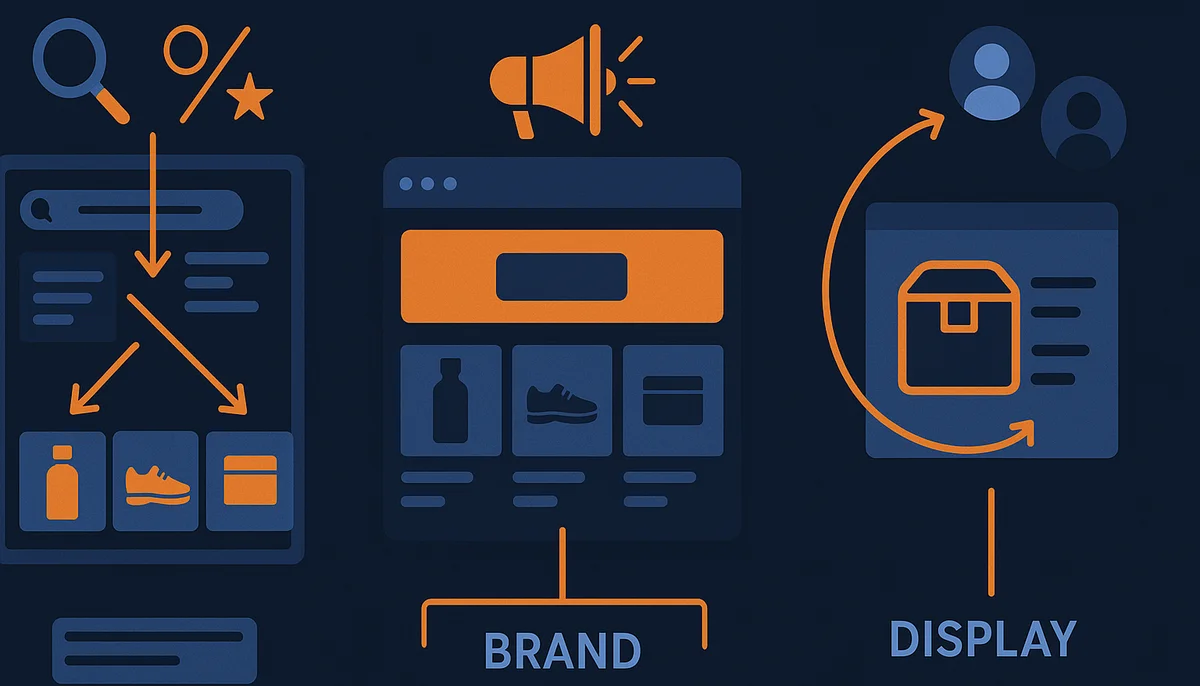
Key Takeaways
• Sponsored Products drive immediate sales by targeting individual ASINs with keyword-based ads that appear in search results • Sponsored Brands build awareness through headline ads featuring your brand logo and multiple products simultaneously • Sponsored Display uses audience targeting and retargeting to capture shoppers both on and off Amazon's platform • The optimal strategy combines all three ad types in a structured campaign architecture that targets different funnel stages
Introduction
Amazon's advertising ecosystem consists of three primary ad types: Sponsored Products, Sponsored Brands, and Sponsored Display. Each serves distinct purposes in your advertising funnel, from driving immediate conversions to building long-term brand awareness. Understanding when and how to deploy each type determines whether you're optimizing for short-term revenue or building sustainable market share. After managing campaigns across 100+ brands, I've seen sellers waste significant budgets by mismatching ad types to their objectives.
Understanding Sponsored Products
Sponsored Products are keyword-targeted ads that promote individual ASINs in Amazon search results and product detail pages. The primary benefit is immediate sales generation through high-intent keyword targeting. These ads appear as "Sponsored" listings within organic search results, making them the closest thing to organic placement you can buy.
The campaign architecture for Sponsored Products includes three targeting options: automatic targeting, manual exact match, and manual broad match. Automatic campaigns let Amazon's algorithm discover relevant keywords, while manual campaigns give you precise control over keyword bidding and negative keyword management.
One of our clients in the home goods category allocated 70% of their advertising budget to Sponsored Products campaigns. By structuring campaigns around product groups and implementing systematic keyword harvesting from auto campaigns to manual exact campaigns, they achieved a 2.8 ACoS while maintaining 40% advertising-attributed revenue growth year-over-year.
The key performance metrics to monitor include ACoS (Advertising Cost of Sales), CTR (Click-Through Rate), CVR (Conversion Rate), and CPC (Cost Per Click). Successful Sponsored Products campaigns typically achieve CTR above 0.5% and CVR above 10% for competitive keywords.
Mastering Sponsored Brands
Sponsored Brands are headline ads that appear at the top of search results, featuring your brand logo, custom headline, and up to three products. The most important criteria for success include brand registry enrollment, compelling creative assets, and strategic keyword targeting aligned with brand awareness goals.
These campaigns excel at capturing top-of-funnel traffic and building brand recognition. Unlike Sponsored Products, which focus on individual product sales, Sponsored Brands drive traffic to your brand store or product collections. The ad formats include headline search ads, video ads, and store spotlight ads.
Campaign structure should prioritize high-volume, category-defining keywords rather than specific product terms. For example, instead of targeting "stainless steel water bottle 32oz," target "water bottles" or "hydration gear." This broader approach maximizes impression volume and brand exposure.
One of our supplement clients increased brand awareness metrics by 45% within six months by implementing Sponsored Brands campaigns targeting category keywords. Their strategy included video creative showcasing product benefits and custom landing pages that highlighted their complete product ecosystem rather than individual items.
Performance benchmarks for Sponsored Brands typically show lower conversion rates than Sponsored Products (5-8% vs 10-15%) but higher impression volumes and brand metric improvements. Focus on impression share, brand new-to-brand metrics, and assisted conversions rather than direct ROAS.
Leveraging Sponsored Display
Sponsored Display campaigns use audience targeting and product targeting to reach customers both on and off Amazon. The key factors include retargeting capabilities, lookalike audience creation, and cross-platform reach extending to third-party websites and apps.
The campaign types include targeting audiences (views remarketing, purchases remarketing, similar audiences), targeting products (individual ASINs, categories, brands), and targeting interests. This flexibility allows for sophisticated funnel strategies that capture customers at different stages of their buying journey.
Audience targeting performs particularly well for retargeting customers who viewed your products but didn't purchase. These campaigns typically achieve higher conversion rates (12-18%) due to the warm audience, though impression volumes are lower than keyword-targeted campaigns.
One of our electronics clients implemented a comprehensive Sponsored Display strategy targeting competitors' ASINs and remarketing to their own product viewers. The competitor targeting campaigns achieved a 4.2% CTR by identifying customers actively shopping in their category, while remarketing campaigns converted at 16% CVR with a 3.1 ACoS.
Product targeting allows you to place ads on competitors' detail pages, capturing high-intent traffic from customers considering similar products. Success requires careful selection of complementary rather than directly competing ASINs to avoid policy violations and maximize relevance.
Campaign Architecture Strategy
The optimal advertising strategy combines all three ad types in a structured hierarchy that addresses different customer touchpoints. The primary approach involves using Sponsored Products for conversion-focused keywords, Sponsored Brands for awareness and category dominance, and Sponsored Display for retargeting and competitive conquest.
Budget allocation typically follows a 60-25-15 split between Sponsored Products, Sponsored Brands, and Sponsored Display respectively. However, brand maturity and category dynamics influence these ratios significantly. Newer brands benefit from higher Sponsored Brands investment for awareness building, while established brands can weight more heavily toward conversion-focused Sponsored Products.
Campaign timing and coordination maximize cross-campaign synergies. Launch Sponsored Display remarketing campaigns after accumulating sufficient traffic from Sponsored Products and Sponsored Brands. Use Brand Analytics data to identify high-performing search terms in Sponsored Products campaigns, then target those keywords with Sponsored Brands for impression share capture.
Our systematic approach involves launching campaigns in phases: start with Sponsored Products auto and manual campaigns, add Sponsored Brands after achieving consistent performance, then layer Sponsored Display for remarketing and competitive targeting. This progression ensures data-driven optimization rather than spreading budget too thin initially.
Performance Measurement and Optimization
The most important metrics vary by campaign type and business objectives. For Sponsored Products, focus on ACoS, TACoS (Total Advertising Cost of Sales), and organic rank improvements. Sponsored Brands require tracking impression share, brand new-to-brand percentage, and assisted conversion metrics. Sponsored Display optimization centers on audience performance, cross-device attribution, and lifetime value metrics.
Cross-campaign attribution proves challenging within Amazon's reporting interface. Use Brand Analytics combined with business reports to understand how advertising campaigns influence organic performance and total account velocity. Track 7-day, 14-day, and 30-day attribution windows to capture different customer decision timelines.
Monthly optimization includes keyword harvesting from auto campaigns, negative keyword refinement, bid adjustments based on performance data, and creative testing for Sponsored Brands campaigns. Quarterly reviews should assess campaign architecture effectiveness, budget reallocation opportunities, and strategic alignment with business goals.
One of our fashion clients improved their overall advertising efficiency by 35% through systematic cross-campaign optimization. They identified that Sponsored Brands campaigns with higher impression share correlated with improved organic rankings for their Sponsored Products campaigns, leading to a virtuous cycle of reduced advertising dependence.
Our Amazon PPC management service implements this comprehensive approach across all campaign types, ensuring optimal performance coordination and budget efficiency.
Frequently Asked Questions
Which campaign type should I start with as a new seller?
Begin with Sponsored Products automatic campaigns to gather keyword performance data and generate initial sales momentum. Add manual exact match campaigns after identifying high-performing keywords from auto campaigns, typically after 30-60 days of data collection.
How do I determine budget allocation between campaign types?
Start with 70% Sponsored Products, 20% Sponsored Brands, and 10% Sponsored Display. Adjust based on business goals: increase Sponsored Brands for awareness building or Sponsored Display for competitive markets with high remarketing opportunity.
Can I run all three campaign types simultaneously for the same products?
Yes, but avoid keyword overlap between Sponsored Products and Sponsored Brands to prevent internal competition. Use Sponsored Products for specific long-tail keywords, Sponsored Brands for broader category terms, and Sponsored Display for audience and product targeting.
What's the minimum budget needed for effective campaign management?
Allocate at least $30-50 per day total across campaigns for meaningful data collection. Sponsored Products need $20+ daily, Sponsored Brands require $15+ for impression volume, and Sponsored Display works with $10+ for remarketing campaigns.
How long before I see results from each campaign type?
Sponsored Products show immediate results within 7-14 days. Sponsored Brands require 30-45 days for brand awareness impact measurement. Sponsored Display needs 14-21 days for audience optimization, longer for cross-device attribution analysis.
Conclusion
Success with Amazon advertising requires understanding how Sponsored Products, Sponsored Brands, and Sponsored Display work together rather than as isolated campaigns. Sponsored Products drive immediate conversions, Sponsored Brands build market presence, and Sponsored Display captures missed opportunities through retargeting. The key lies in systematic implementation, data-driven optimization, and patience with the learning phases each campaign type requires.
Ready to implement a comprehensive advertising strategy that maximizes all three campaign types? Get a free Amazon account audit to identify optimization opportunities across your current advertising setup. Contact us to discuss your specific advertising goals and develop a systematic approach that scales with your business.
Ready to Optimize Your Amazon Listings?
Request a free audit and discover how we can boost your brand's visibility and sales.
Get Your Free AuditOperations & Execution - Listed in the Amazon Service Provider Network
Ana manages Amazon PPC campaigns for top European brands, focused on reducing ACoS and growing organic sales through data-driven advertising strategies.